The Department of Justice has formally admitted that federal officials “exerted substantial coercive pressure” on Twitter to suppress journalist Alex Berenson’s speech, and has paid him a six-figure settlement to resolve his claims.
The settlement, announced on May 11, 2026, is the first known instance in which an individual American has received a monetary payment from the federal government to resolve a lawsuit alleging unconstitutional jawboning of a social media company. It is one of the most consequential developments to date in the ongoing legal reckoning over the federal government’s pandemic-era pressure campaigns against online platforms.
The operative language in the settlement is unequivocal. The government conceded that it “did in fact violate the First Amendment by exerting substantial coercive pressure on social media companies such as Twitter to suppress disfavored speech” like Berenson’s. That admission, from the United States itself, follows years of denials and obfuscation by Biden-era officials regarding their communications with the platforms.
The Tweet That Triggered the Ban
Berenson, a former New York Times science reporter, was suspended from Twitter in August 2021 after publishing a now-famous post observing that the COVID-19 mRNA vaccines did not stop infection or transmission. Denounce as “misinformation” at the time, Berenson’s observation was later confirmed by CDC Director Rochelle Walensky and by Pfizer executive Janine Small in on-the-record settings.
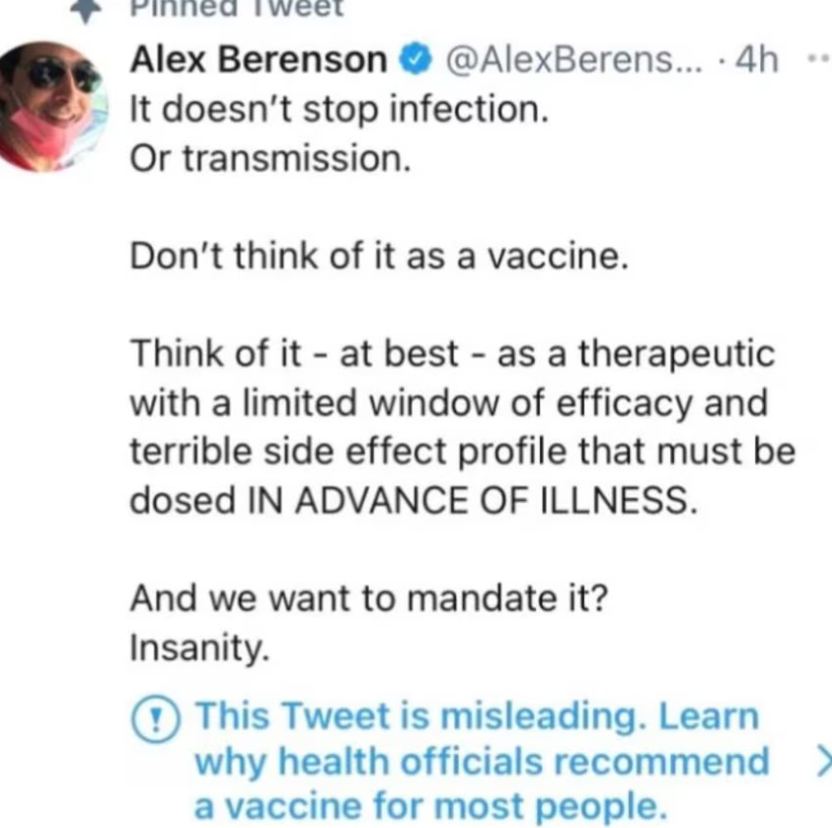
Pictured: the tweet that triggered the ban
According to materials already produced in the litigation, Berenson’s ban did not originate organically within Twitter’s trust and safety apparatus. Internal communications show that Twitter’s senior leadership had questioned whether Berenson had violated any platform policy at all.
The decisive intervention came from outside the company. Dr. Scott Gottlieb, the former FDA Commissioner who simultaneously served on Pfizer’s board of directors, privately contacted Twitter’s top White House lobbyist, Todd O’Boyle, and urged action against the Berenson account. This was one of the clearest examples of a government official initiating a social media ban of a journalist.
A Pattern Now Documented in Court Filings
The Berenson settlement does not exist in isolation. It joins a growing record of court findings, congressional disclosures, and discovery productions documenting a coordinated apparatus through which federal officials pressured social media platforms to remove specific speakers and viewpoints.
That record includes direct communications between White House staff and platform employees demanding the removal of named accounts; coordination with private-sector intermediaries, including, in this case, a pharmaceutical executive financially interested in suppressing skepticism of his own product; and targeting of disfavored viewpoints rather than content failing any neutral, pre-existing platform standard.
What sets the Berenson settlement apart is the government’s own acknowledgement of the constitutional violation. Prior matters, including Murthy v. Missouri, were resolved on standing grounds without a merits ruling. Here, the United States has stipulated to the wrongdoing.
The Case Continues Against Pfizer
While the settlement releases the federal government, Berenson’s lawsuit proceeds against Gottlieb and Bourla in their personal capacities. The remaining claims are anchored in 42 U.S.C. § 1985(3), the Reconstruction-era statute that creates a civil cause of action against private conspiracies to deprive Americans of federally protected rights.
Berenson and his counsel, James Lawrence of Envisage Law, have appealed the prior dismissal by Judge Jessica G.L. Clarke of the Southern District of New York to the U.S. Court of Appeals for the Second Circuit. The government’s settlement, and its accompanying admission, came on the eve of the deadline for its responsive brief in that appeal.
The central question now before the Second Circuit is whether unvaccinated Americans constitute a class entitled to the protections of § 1985(3). Put another way, the court must decide whether they retain the same right as other disfavored groups to speak to one another free from coordinated suppression by state and private actors.
Legal Precedent Against Censorship
For years, defenders of the Biden administration’s coordination with social media companies have insisted that the contacts were benign, advisory, or constitutionally unremarkable. The United States has now stipulated otherwise, in writing, in federal court.
The implications extend well beyond a single journalist. If § 1985(3) is held to reach the kind of public-private censorship coalition documented in the Berenson record, the legal exposure for individual officials and corporate executives who participated in similar campaigns becomes substantial. Discovery, long resisted, would finally proceed.
The settlement represents a major milestone in broader legal arguments against government meddling in online speech. The censorship apparatus that took shape during the pandemic was not built by the government alone, and it will not be dismantled by a single payment. But for the first time, the United States has admitted, on the record, that the apparatus violated the First Amendment. That admission is now part of the public record.