SUMMARY
- The idea of European digital sovereignty has become a major narrative for the censorship industry following their loss of influence in Washington DC and Silicon Valley.
- Once supported by American tax dollars and Big Tech donations, “disinformation researchers” are now calling for the EU to fully replace the “American tech stack,” promoting alternatives like EuroSky, an EU-backed version of BlueSky.
- At the recent Cambridge Disinformation Summit, one panelist even suggested the use of “kinetic options,” aka the military, to enforce decisions against American tech companies.
- Another disinformation professional has called for an “Airbus for the internet,” envisioning a domestic tech industry backed by state subsidizes, similar to European aerospace.
- The censorship industry’s new vision points to a Great Firewall of Europe, cutting off European citizens from American platforms.
The censorship industry, having simultaneously lost influence in Washington, D.C., and Silicon Valley, is now openly turning on the American tech platforms it once worked through — with a growing chorus of “disinformation researchers” calling for an independent European internet to displace U.S. companies, and at least one speaker at a recent summit suggesting that “kinetic methods,” up to and including military force, may eventually be required to enforce compliance.
“Digital sovereignty” has become the buzzword of choice for a coordinated EU effort to either replace or destroy American tech companies, now that the latter have stopped dancing to the censorship industry’s tune. The Atlantic Council, in its report titled “Digital Sovereignty: Europe’s Declaration of Independence?”, documents the term’s rise to a “central — albeit nebulous and controversial — guiding principle” for European engagement on digital affairs.
Following the Trump administration’s day-one reversal of U.S. federal support for online censorship, the ad industry’s retreat, partly compelled by the FTC, on collective boycotts aimed at controlling content, and Silicon Valley’s new reluctance to work with the censorship industry, foreign jurisdictions are one of the last remaining vectors for the censorship industry (the previous administration’s digital regulation regime in exile) to exert control over online speech.
“Kinetic Methods” at the Cambridge Disinformation Summit
The recent Cambridge Disinformation Summit was host to some particularly radical remarks on the need to dislodge American tech companies from Europe. One speaker, Robin Berjon, deputy director of the IPFS Foundation, repeatedly suggested that jurisdictions wishing to regulate American tech companies — including the UK and the EU — will eventually have to resort to “kinetic methods,” up to and including the military, to force compliance.
Berjon joked that he wasn’t advocating that the EU should “go and start shooting Google just yet,” but reiterated that an approach to American tech that rested solely on regulation would eventually have to be backed by the use of force.
“And this is not to say that regulation isn’t helpful. It helps, but it can’t be the only solution because compared to the power of these infrastructure providers, you would have to apply regulation very forcefully, potentially up to and including kinetic methods in order to apply it. So it’s not enough on its own.”
“Moderator: Can I underscore what do you mean by kinetic methods?”
“Using the military. Yeah.
And I’m not making, you mentioned nato. The manual does include kinetic as one option in case of disordered information environments. But I’m not advocating that we should go and start shooting Google just yet. But the thing is, if you want to do just regulation, you have to be willing to go all the way up to force. Otherwise, it’s just not powerful enough to counter this control of infrastructure. And same thing with other approaches that we’ve tried over the past 15 years.”
Berjon then characterized American tech companies as “private governments” that have “aligned with the U.S. government,” and argued that European powers will have no choice but to escalate:
“I think the Clinton administration is the driver there. They saw internet commerce as an explicitly libertarian project. It’s very explicitly said that private companies must lead by which they mean govern. And we’re currently in a world of private government by these companies. And it so happens that yes, those private governments, those private governments have aligned with the US government. And this is challenging certainly for Europeans, but other middle powers to push back on. I do think however, that the more we yield, the more we will continue yielding. And so it’s not as if we have an option. It’s not as if I want kinetic options, but the more we push, the more it’s likely that they will use them. We just have to be ready. And so I would say yes, the geopolitics of it are very painful, very difficult, but I don’t think we have a choice.”
Berjon’s alternative to “kinetic options,” which he expressed repeatedly throughout the panel, is the creation of a European tech infrastructure that can replace Silicon Valley companies and ensure “digital sovereignty.”
An “Airbus for the Internet”
University of Copenhagen professor Rasmus Nielsen was one of the first to open up the “sovereignty” narrative, proposing shortly after the second inauguration of Donald Trump that Europe adopt an “Airbus for the internet” plan to free itself from reliance on “irritating Yankees” – American tech companies. Nielsen calls his plan the “Airbus solution,” comparing the problem of digital infrastructure to the EU’s state-subsidized aerospace sector.
And that solution essentially is what I would suggest we can think of as, the Airbus solution. So you have irritating Yankees, who dominate an important, strategically important part of the economy, in issues of, national importance, political interest, public importance, and you respond to that through a mix of industrial policy, maybe some state support, maybe some strategic procurement practices maybe some nudging of mergers and consolidation.
Nielsen also suggested that state-backed tech companies may look something like state-run media companies like the UK’s BBC.
instead- what one would be looking at there would be, what former Labour leader, in the UK, Jeremy Corbyn, briefly floated as the idea of a BDC, a British Digital Corporation, as a counterpart to the BBC, the British Broadcasting Corporation, as a publicly funded, arm’s length governed, public service alternative to for-profit incumbents.
Why now? Nielsen doesn’t conceal the censorship industry’s motivations — it’s because of the “emergence of a new regime in Washington” that no longer cooperates with the demands of disinformation researchers.
…there’s a disavowal of years of work, and sudden changes of direction that happens to coincide with the emergence of new power in Washington, D.C. And in this moment, there is a resurgent insistence on the need for European alternatives.
Nielsen is a Faculty Affiliate of the Shorenstein Center at Harvard University, an institution that played a pioneering role in the censorship industry. The Shorenstein Center was led for years by Joan Donovan, who became infamous for repeatedly claiming that the Hunter Biden laptop was not genuine. The Shorenstein Center also birthed two other key “anti-disinformation” initiatives: First Draft and the Algorithmic Transparency Initiative.
Ironically, Nielsen is affiliated with an institution that was itself funded by the very American tech companies he now wants Europe to displace. During the heyday of the censorship industry’s influence, the Shorenstein Center received money from Google and Facebook, as well as Craig Newmark Philanthropies and the Gates Foundation.
At the Cambridge Disinformation Summit, “Responsible AI” professor Gina Neff also tied the emergence of the EU “digital sovereignty” idea to the second election of Trump, saying that the thought of independence from the “American tech stack” would have been “unthinkable” just eighteen months ago.
EuroSky and the Return of the Gatekeepers
What will an independent European digital infrastructure look like? At the Cambridge Disinfo Summit, Berjon repeatedly urged attendees to join EuroSky, the EU-promoted version of Bluesky in which he is involved.
Throughout the panel, Berjon called for attendees to “take fifteen minutes out of your day” and sign up for EuroSky, a call that was echoed by Neff.
Berjon sees widespread adoption of EuroSky as the first stage in a multi-step process to replace American tech companies with European ones.
Like Nielsen, he also described a future in which state-run media companies like the BBC operate their own social media algorithms — restoring the power of traditional media gatekeepers over the flow of information.
“We need our own infrastructure. And the question is like, okay, let’s do infrastructure. The first thing that people go to is like, oh, are we going to have state run social media? That’s kind of terrifying. And also people are very worried that it’ll be uncool if nothing else. And there are multiple ways of running it.
There are many solutions. There are many sources of people who can run infrastructure. There’s of course states, and we have the public broadcaster model as a system. It doesn’t mean that you necessarily get only say, BBC recommendation engines, BBC content moderation, but you can run the infrastructure and allow people a lot of flexibility on top of that. That’s one model.”
Berjon further described the problem of “authoritarian” digital infrastructure providers producing an “authoritarian” society — apparently without irony, only minutes before suggesting the use of military force to shut down American tech platforms.
“Now, we’ve tended to forget that infrastructure is able to set rules because we’ve generally regulated infrastructure or providers such that they’re not allowed to set their own rules or only within very strict parameters. But we haven’t done that on the internet. And so because infrastructure set rules, if you have authoritarian infrastructure providers, you have an authoritarian society running on top of it. And that is the problem of sovereignty. So again, how do we fix this? What do we do about this? Well, there’s no *way out other than producing and controlling our own infrastructure, replacing these systems with our own.”
A Great Firewall by Another Name
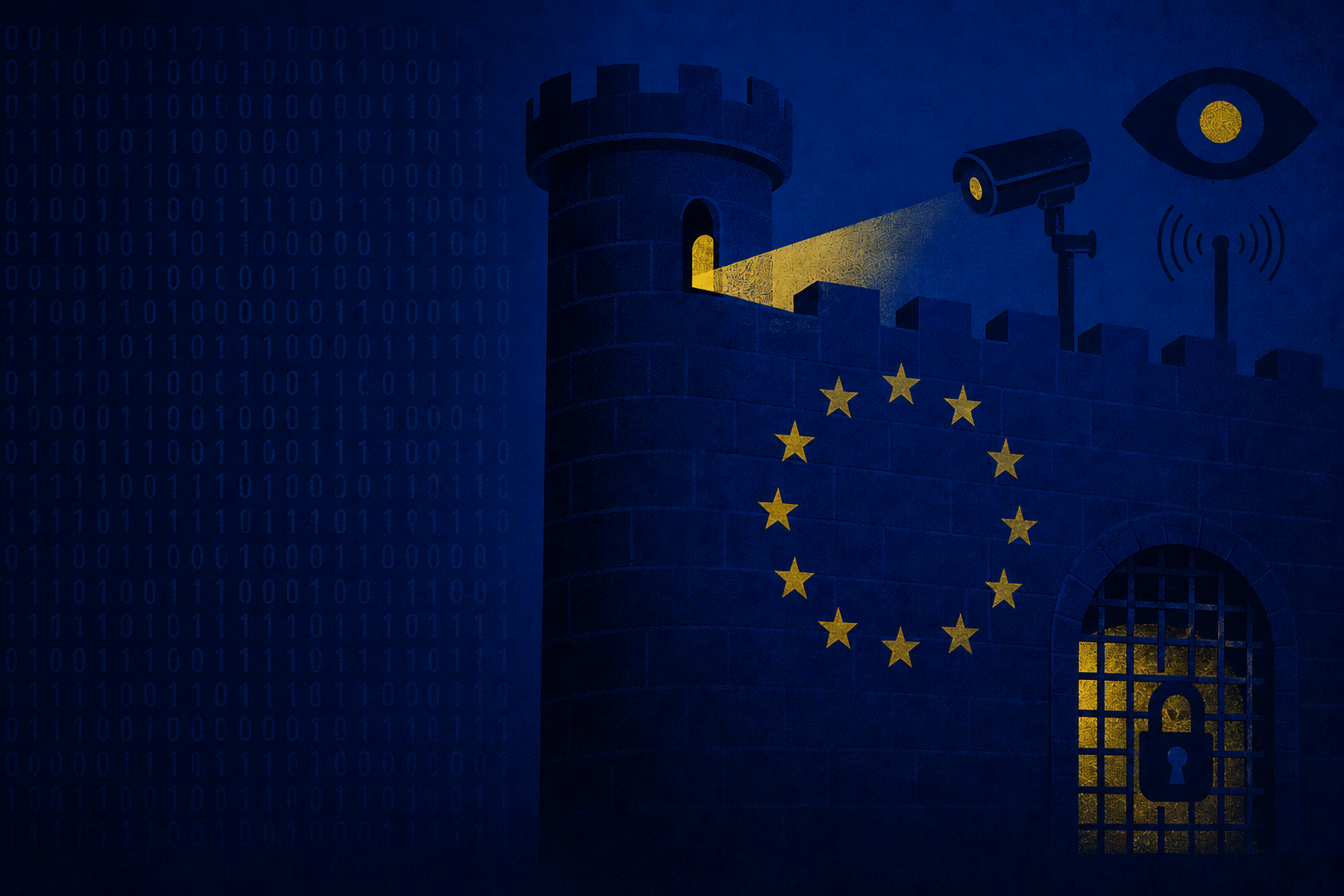
What Berjon, Nielsen, and the broader “digital sovereignty” coalition are describing is, in effect, a Great Firewall of Europe — a walled-off internet whose infrastructure is controlled by European states and their preferred public broadcasters, in which the legacy gatekeepers reclaim the recommendation engines, and the flow of information is once again routed through the kinds of institutions the censorship industry has historically been able to influence.
Under the Digital Services Act, the EU has relentlessly targeted X, the platform most associated with Silicon Valley’s shift back towards free speech. X became the first platform to be investigated and fined under the DSA with civil society taking credit for the $140 million penalty against the platform, which targeted its independence from disinformation researchers and subscriber revenue stream.
This EU aggressiveness did not appear out of thin air. As the Foundation for Freedom Online has previously reported, the United States under the Biden administration helped shape the Digital Services Act and the wider European regulatory regime through the US International Trade Administration, the Office of the U.S. Trade Representative, and the US-EU Trade and Technology Council. The previous administration welcomed additional pressure on American tech platforms as a means of censoring domestic political opponents, funneling more than $15 million in U.S. taxpayer dollars to a network of 23 organizations now involved in enforcing the EU’s censorship regime.
The new push for European “digital sovereignty” is the same project the previous U.S. administration pursued through the Digital Services Act and the EU Code of Practice on Disinformation, only now stripped of any pretense of partnership with American platforms. With its domestic levers cut and Silicon Valley unwilling to play along, the censorship industry’s adherents are openly contemplating what was unspeakable a year and a half ago: replacing American tech companies entirely — and, if regulation alone proves “not enough on its own,” backing up the regulators with the military.