On May 17, TikTok removed a campaign video by Reform UK’s Shadow Home Secretary, Zia Yusuf, in which he criticized mass migration and announced the party’s policy of placing illegal-migrant detention centers in constituencies that vote for pro-migration parties.
Yusuf reported that TikTok subsequently removed a second video of his, outlining the policies he would implement as Home Secretary, and warned him that further “violations” would risk a permanent ban. His TikTok account had received 18 million views in the previous 28 days, making it one of the largest and fastest-growing political accounts on the platform. Reform UK leader Nigel Farage called the takedowns “unacceptable political interference from a big tech company.” Yusuf was more direct: “Labour is using the Online Safety Act to silence political opponents, and TikTok is doing their dirty work.”
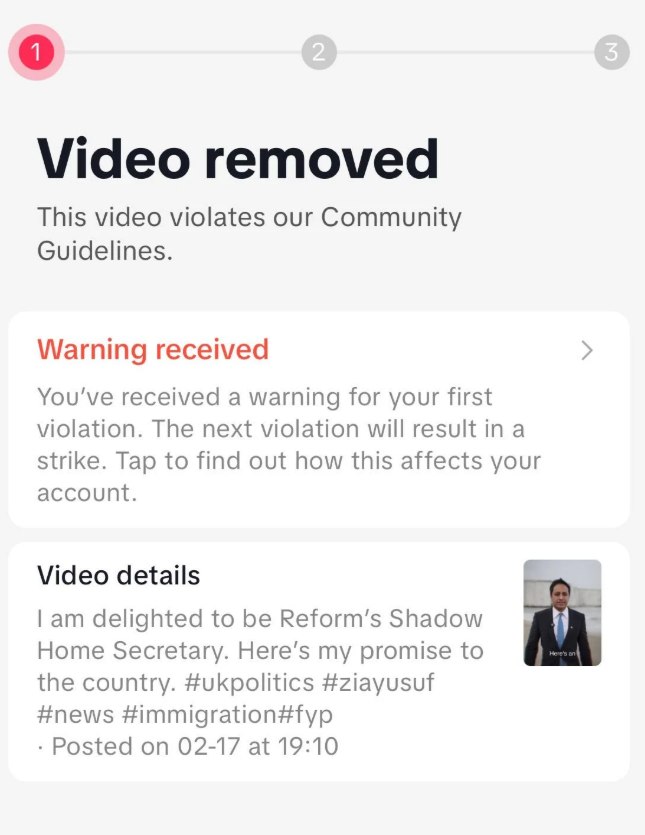
After widespread public outrage, TikTok reinstated the videos and claimed the removals were “in error.” But the underlying machinery that produced the error is no error at all. It is the UK’s Online Safety Act working as designed. The reporting tool used to flag Yusuf’s video to TikTok’s content moderators as “hateful conduct” is a mechanism that all social platforms must offer in the UK, by law, thanks to the Online Safety Act.
What the Online Safety Act actually does
As FFO has previously documented, the Online Safety Act was sold to the British public as a measure to protect children. The reality is far broader. The Act gives UK authorities sweeping powers to punish tech platforms for carrying content the government classifies as disinformation or hate speech, and it does so under a vague and elastic definition of “harm” that easily sweeps up mainstream political speech.

The Act’s enforcement architecture is designed to ensure compliance even from foreign companies with limited UK exposure.
- Criminal penalties for foreign tech employees. Senior managers at companies found to be non-compliant with the law are subject to criminal penalties, with a maximum prison sentence of two years. That means the UK has given itself the power to jail American tech employees for refusing to censor US-protected speech.
- Massive financial penalties. The UK’s online regulator, Ofcom, can levy fines of £18 million or 10 percent of worldwide revenue on non-compliant companies, whichever is higher. That is comparable to the EU’s equally censorious Digital Services Act, which permits fines of up to 6 percent of global annual turnover.
- Forced advertiser and payment-provider boycotts. The Act enables the UK to compel a non-compliant company’s advertisers and payment providers to stop working with the targeted website or service. This has international implications. A US-based site with a minimal number of UK users may feel comfortable defying Ofcom. Its advertisers and payment providers may not. The UK government has given itself the power to force advertiser boycotts and financial blacklisting against any company, anywhere in the world.
Every one of these tools is calibrated to make compliance the path of least resistance, especially for global platforms whose UK revenue is a fraction of their worldwide business but whose worldwide business is now exposed to UK fines.
Censoring domestic opposition
The OSA has now produced what its critics warned it would produce: the censorship, however briefly, of the country’s leading opposition party. Reform UK has led UK polling for months, with double-digit leads over the governing Labour party, and would likely win a governing majority if an election were held tomorrow. The party’s policy platform on immigration is mainstream by any historical measure of British politics. It is also the single largest political vulnerability of the current Labour government.
The OSA’s content-reporting mechanism allowed an anonymous complainant to flag Yusuf’s video. TikTok, facing the financial and criminal exposure the Act creates, removed it. The “Hate Speech and Hateful Behaviour” rule TikTok cited is precisely the kind of vague, elastic standard the OSA is designed to import into platform moderation policies.
That the takedown was reversed after public outcry is not a vindication of the system. It is a demonstration of how the system runs in the absence of a viral political backlash: silently, against smaller voices, with no public reversal.
The real target: foreign platforms
The goal of laws like the OSA is not merely to censor domestic opponents. It is to influence the global content-moderation policies of foreign tech platforms.
The House Judiciary Committee has already revealed that TikTok adjusted its global content policies to comply with the EU’s Digital Services Act. This is precisely what such laws are intended to achieve: control over American speech as well as local speech, exercised through pressure on US-based platforms.
In 2024, TikTok explicitly revamped its global Community Guidelines to “achieve compliance with the Digital Services Act,” incorporating DSA-mandated changes that now censor true information and vague categories of protected speech worldwide, including in the United States. Internal documents reveal TikTok’s updates included bans on “marginalizing speech” and “out-of-context media,” categories broad enough to sweep up conservative viewpoints on gender and other contested issues.

This was revealed in TikTok’s own “Community Guidelines Survey,” which solicited user feedback on upcoming changes. The survey openly admitted:
“The primary motivation for the next round of CG updates is to achieve compliance with the Digital Services Act (DSA).”
TikTok planned a smaller update in Q4 2023 and a larger one by the end of H1 2024, directly tying these revisions to DSA requirements. The document amounts to a confession by TikTok that EU regulation drives its global censorship policies.
Following EU pressure, TikTok began censoring mainstream conservative claims, including the statement “there are only two genders,” labeling it as hate speech or disinformation. The policy, born from DSA compliance meetings, applies universally. Americans debating transgender issues in women’s sports or bathrooms now face demonetization, demotion, or outright removal on the platform.
The Committee further uncovered that TikTok’s actions stemmed from pre-election huddles with the European Commission, where platforms were instructed to “adapt their terms and conditions” to crack down harder on disfavored narratives.
This is also why the Biden Administration helped bring the DSA into existence. Despite the DSA being a European law, US officials understood that European censorship regimes would help suppress the American opposition as well. The OSA and the DSA are not parallel domestic problems. They are connected nodes in a transatlantic censorship architecture, and they were built that way on purpose.
The brief silencing of Reform UK’s Shadow Home Secretary on TikTok is a preview of how that architecture operates against domestic political opposition. The next time the takedown will not be reversed, because the next time there will not be a viral backlash to force the reversal. The Online Safety Act is doing what it was built to do.