SUMMARY
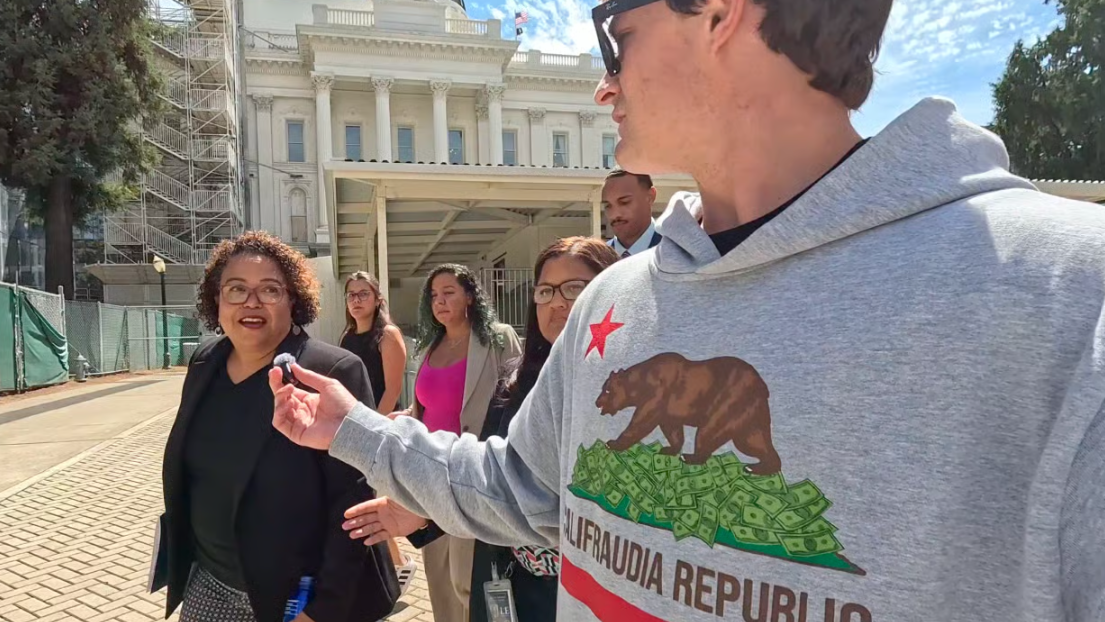
- Independent journalist Nick Shirley has sued California Attorney General Rob Bonta and Secretary of State Shirley Weber, asking a federal court to block the speech-related provisions of AB 2624 before they become operative.
- The complaint alleges that the law remains content- and viewpoint-discriminatory, overbroad and vague despite amendments adopted after a public backlash forced California lawmakers to retreat from the bill’s original censorship regime.
- Shirley says AB 2624 has already caused him to self-censor and could expose both future investigations and previously published reporting to civil or criminal consequences.
- The case will test whether California may protect a politically selected category of immigration-support organizations through litigation-backed takedown demands while leaving lawful public-interest reporting exposed to years of uncertainty.
California’s attempt to protect immigration-support organizations from unwanted scrutiny has moved from the legislature to the courts. Independent video journalist Nick Shirley filed a federal lawsuit on 4th September, challenging key provisions of Assembly Bill 2624, the measure opponents have labelled the ‘Stop Nick Shirley Act’. The action was filed in the US District Court for the Eastern District of California against Attorney General Rob Bonta and Secretary of State Shirley Weber.
The lawsuit follows the enactment of AB 2624 by Governor Gavin Newsom on 22nd August this year. The law will become operative at the start of October 2027, but Shirley has brought a pre-enforcement challenge arguing that its passage is already changing what he is prepared to investigate and publish.
His requested injunction targets Government Code sections 6218.18 to 6218.21, which regulate online publication, create private causes of action and establish a new criminal offence, together with the definitions on which those provisions depend.
The 22-page complaint, filed by America First Legal and California counsel, advances five claims: facial and as-applied content and viewpoint discrimination under the First Amendment; First Amendment overbreadth; vagueness under the Fourteenth Amendment; and a violation of the Constitution’s prohibition on state ex post facto laws.
At the center of the case is the statute’s sweeping definition of ‘personal information’. The final text of AB 2624 covers not only home addresses, telephone numbers and identification documents, but names, physical descriptions, employment, employment history and financial information. An ‘image’ includes photographs, video footage, sketches and computer-generated images capable of identifying somebody.
Those categories overlap directly with ordinary reporting. Shirley says he intends to continue investigating the funding, government contracts, political advocacy and legal compliance of organizations providing immigration services. Such work may require publishing the identities, professional affiliations, employment histories, photographs and video footage of people involved. The complaint says he has already refrained from otherwise lawful research and publication because of the threat of enforcement.
AB 2624 generally makes publication actionable only when the publisher acts with the specific intent to incite imminent great bodily harm that is likely to occur, or to threaten a protected person in a way that places them in objectively reasonable fear for their safety. California will point to that high intent threshold as evidence that the law reaches threats rather than journalism.
Shirley’s answer is that liability would still turn on a judge or jury reconstructing a speaker’s subjective purpose after publication. A reporter cannot know in advance how hostile plaintiffs will characterize his motives, and the cost of proving lawful intent may itself deter publication. The statute allows protected participants, or organizations authorized to act for them, to send written demands that remain effective for four years. A successful injunction claim carries court costs and reasonable lawyers’ fees; other violations can produce damages of up to three times actual loss, with a minimum award of $4,000.
There is no express journalism exemption in the enacted text. More importantly, the law does not merely distinguish threatening speech from protected speech. It grants special protections to people associated with ‘immigration support services’, while providing no comparable regime for organizations or individuals advocating stricter immigration enforcement. The complaint argues that this political asymmetry is content and viewpoint discrimination, reinforced by legislative findings blaming ‘anti-immigrant’ harassment on the federal administration’s ‘anti-immigration attitude and policies’.
The vagueness claim focuses on open-ended phrases including ‘services provided to the immigrant population’, facilities including but not limited to law offices and healthcare facilities, and ‘repeated, unreasonable, and unwelcome conduct’. According to the complaint, those definitions fail to tell reporters when persistent questions, criticism or public-interest investigation might be treated as harassment, or even which people and facilities fall within the protected category.
The fifth claim concerns old material. AB 2624 defines public posting as intentionally making information available to the general public. Shirley argues that prosecutors or private claimants could treat previously published videos that remain online after 1st October 2027 as continuing publication, attaching new criminal consequences to conduct that was lawful when completed. He is asking the court to declare the challenged sections unconstitutional and prevent their enforcement against him or anybody else.
As FFO previously reported, Mia Bonta’s original bill would have allowed protected workers to send demands broadly preventing people from continuing to publish their images or personal information for four years, without requiring proof that the publication was a threat or incitement.
Newsom Signs Watered-Down “Stop Nick Shirley Act” After Backlash Forces California Retreat
Bonta and Democratic lawmakers advanced that language until criticism from Shirley, Republican legislators and free-speech organizations made its implications politically impossible to ignore. The final version added the specific-intent requirements and more closely tracked constitutional standards for threats and incitement. Days after Newsom signed it, members of the Republican Study Committee urged US Attorney General Todd Blanche to bring a federal challenge of his own.
The Foundation for Individual Rights and Expression described the amendments as an important improvement and said they prevented the demand-letter provision from being unconstitutional on its face. That assessment is a significant counterpoint to Shirley’s facial challenge. But FIRE also warned that frivolous demands could still frighten speakers into removing lawful material and said the private-lawsuit section did not clearly incorporate every limitation added elsewhere in the bill.
Bonta has rejected the suggestion that AB 2624 targets reporters. After its enactment, she said the law protected both immigrant-service workers and the press, insisting that ‘those two freedoms were never in tension’. Protecting people from genuine threats is a legitimate state interest. The constitutional question is whether California pursued that interest narrowly, or created a politically selective system capable of punishing and chilling a much wider range of speech.
In New Jersey, a police official invoked Daniel’s Law against a local journalist seeking to report a lawfully obtained address relevant to whether the official lived too far from the city he served. The New Jersey Supreme Court ultimately upheld the restriction, demonstrating that these disputes can move rapidly from theoretical warnings to direct restraints on reporting.
‘Media Literacy’ and ‘Digital Citizenship’: Smuggling Censorship and Indoctrination Into Schools
AB 2624 also sits within a wider Californian effort to manage the production and consumption of online information. FFO has documented how Newsom signed AB 873 in 2023, embedding state-approved ‘media literacy’ material across school curriculum frameworks. Resources promoted by the California Department of Education encouraged reliance on approved fact-checkers and organizations with records of supporting restrictions on lawful political speech.
California’s restrictive online legislation doesn’t stop there. As FFO’s investigation into the British 5Rights Foundation showed, AB 2273 placed pressure on websites either to treat every visitor as a child or to deploy age-assurance systems capable of sorting children from adults. Litigation over the law remains ongoing: in March 2026, the Ninth Circuit narrowed a lower-court injunction but left several challenged provisions blocked, including data-use and ‘dark patterns’ restrictions it found unconstitutionally vague.
Michael Benz is the Executive Director of the Foundation for Freedom Online. Previously, Mr. Benz served as Deputy Assistant Secretary for International Communications and Information Technology at the U.S. Department of State. Follow him on Twitter @FFO_Freedom.