SUMMARY
- The RAND corporation receives hundreds of millions of dollars in U.S. taxpayer funding anually via the federal government.
- RAND has partnered with METR, the well-funded AI safety org that Anthropic wants to embed as government-mandated AI safety evaluators in every company, despite concerns over the organization’s ideological biases.
- The joint RAND-METR initiative is backed by $38 million, aims to build pre-deployment evaluation frameworks for the entire AI industry.
- It is not the first time that RAND has tried to insert itself as intermediaries between the public and digital products – it previously backed NewsGuard, the controversial media blacklister, as an intermediary between the public and online news, even advocating the use of government mandates to force such “middleware” services onto social media platforms.
- Top RAND scholar Francis Fukuyama, at the height of the censorship industry’s power, declared on a public panel that freedom of speech was an “18th century idea” and that we should “dream big” to modify the First Amendment.
As the debate about AI safety grips policymakers across the world, it may surprise Americans to learn that their tax dollars are already at work on a $38 million initiative with METR (Model Evaluation and Threat Research), the AI safety institute that Anthropic’s Dario Amodei hopes will be installed, by government fiat, as third-party “safety” evaluators standing between AI companies and the services they offer the public.
Anthropic’s promotion of METR has become controversial, due to the company’s close ties to the AI safety institute, and the fringe opinions of METR’s CEO, who has defended open borders. President Trump and the Republican leadership have urged caution on Anthropic’s call for top-down regulation, which would grant vast powers over the industry to METR.
Despite this opposition from the elected President and the current House leadership, US taxpayer dollars are already at work bolstering METR’s resources and credibility, through a collaboration with the RAND corporation, a think thank that has been joined at the hip to the US government since its founding.
Source: RAND corporation.
RAND came to life in the closing months of World War II as a collaboration between the U.S. Air Force and Douglas Aircraft, later McDonnell-Douglas. RAND was seen as a means for newly-demobilized scientific and engineering talent to continue assisting the military and the government, without working directly for it.
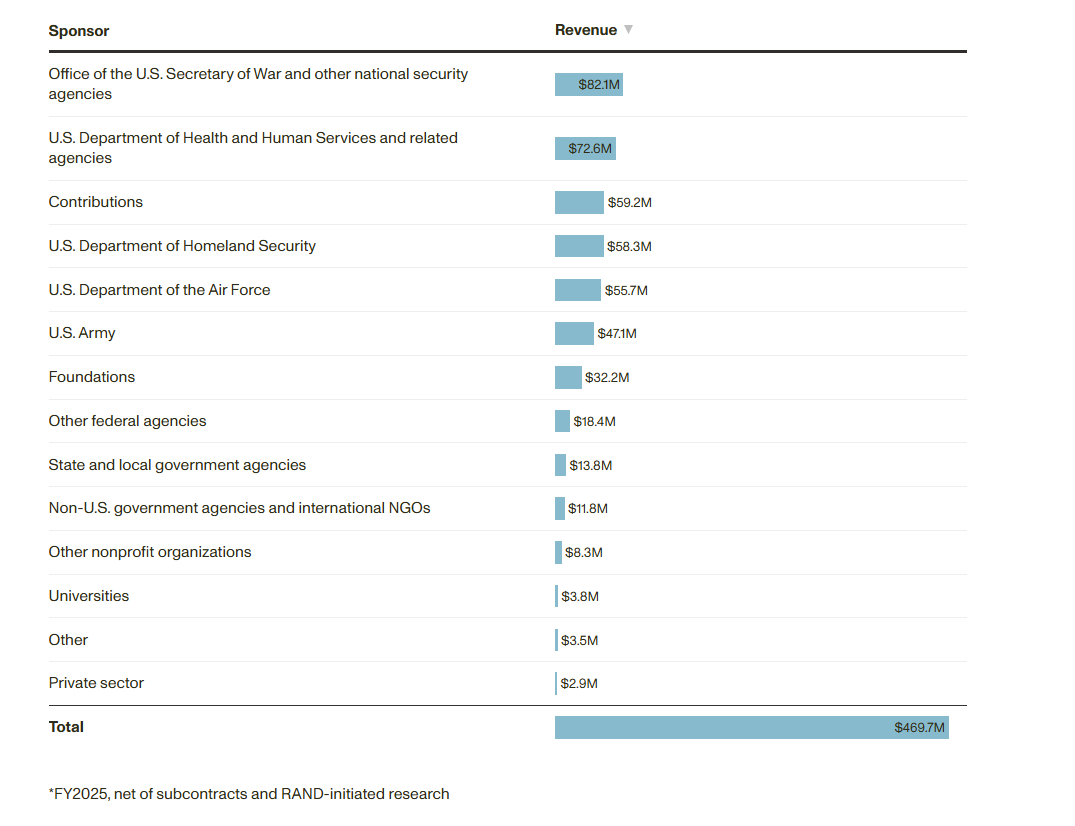
Those deep government and defense-establishment ties have persisted. RAND’s latest public funding page reports $469.7 million for FY2025, including $334.2 million from federal agencies, about 71 per cent. Major sources of funding include the Department of War, DHS, the Army, and the Air Force.
Government sponsorship is not a peripheral feature of RAND’s operating model; it underwrites a large share of the institution that, in collaboration with METR, may soon be writing AI safety guidelines that define the entire industry.
RAND’s Role in AI Safety
RAND’s role in frontier AI safety is not just producing research; it is helping build the tests that determine which capabilities count as dangerous and how those judgements reach laboratories and policymakers.
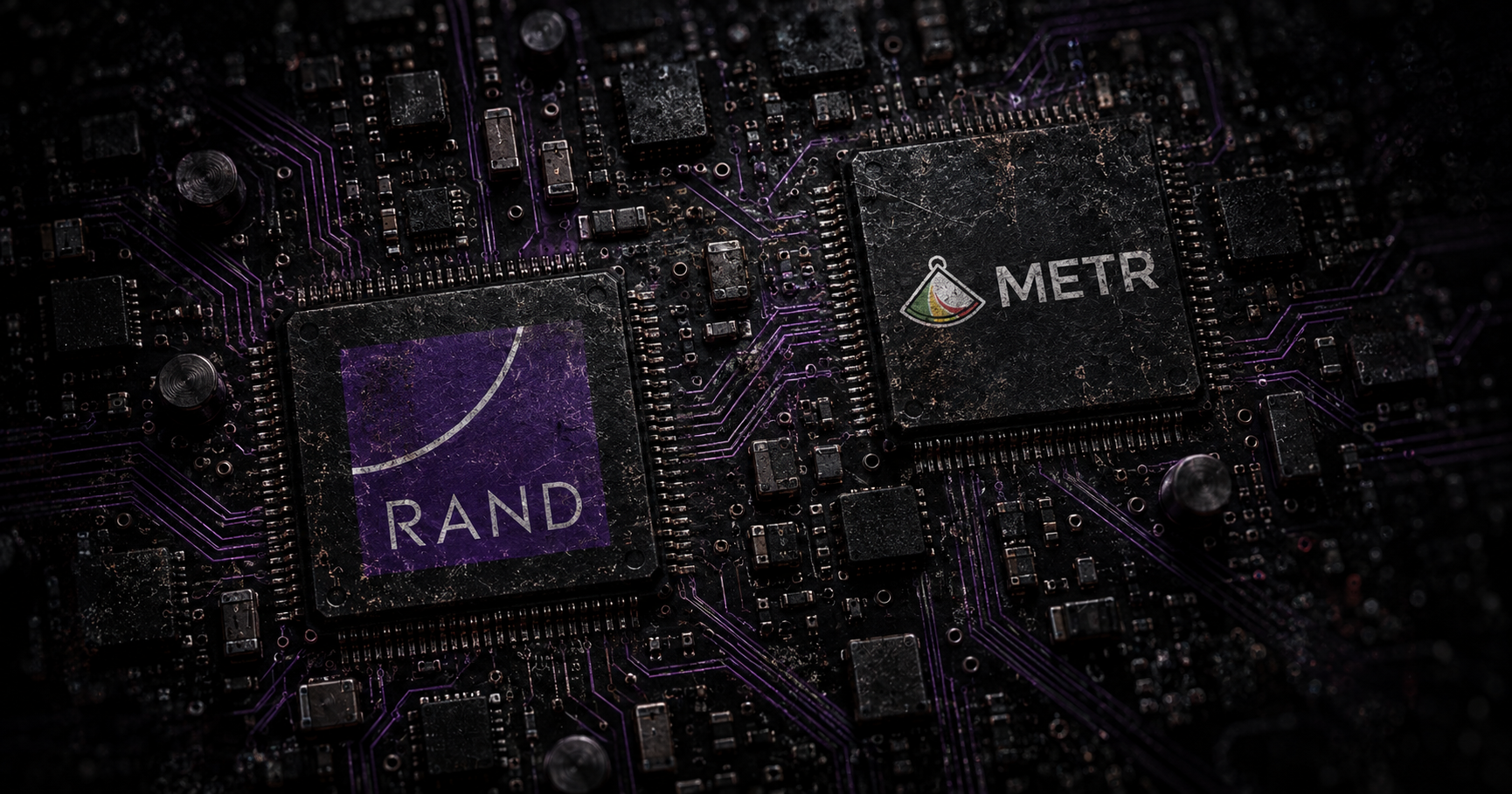
RAND and METR are collaborating on an initiative called, Canary, a roughly $38 million programme to evaluate frontier systems before release: this is precisely the process that Anthropic now wants to be mandated globally, by regulation.
Evaluators influence a decisive point: which capabilities are labelled hazardous, which systems are considered safe enough to deploy, as well as what evidence governments and the public are given from under the hood of the AI frontier models.
The issue reaches beyond funding. Frontier AI safety depends on tests, risk categories and benchmarks that turn uncertain scenarios into findings for companies, governments and journalists. RAND’s evaluation work sits beside a record of shaping responses to alleged information risks. The common thread is institutional power to classify—to decide which capabilities count as dangerous and which sources count as credible.
Censorship, content ratings and middleware
RAND’s 2019 report, “Fighting Disinformation Online,” called the media blacklisting outfit NewsGuard “one of the best examples” of a credibility-scoring tool. NewsGuard rates news sources’ reliability through a browser extension and licenses its ratings to advertisers and internet and mobile providers, one which has investigated by Congress over persistent censorship and ideological bias controversies.
In 2021, top RAND scholar Francis Fukuyama identified NewsGuard by name as a middleware model “we would like to see more of.” That is a clear institutional endorsement of the underlying approach: use ostensibly neutral third-party “experts” as intermediaries between the public and digital information.
NewsGuard Strategy Revealed: Financial Throttling, Virality Suppression, Institutional Partnerships
Middleware is the mechanism that turns this philosophy into infrastructure. It sits between a platform and its users, reading the platform’s information stream and changing what appears: ranking some material higher, filtering other posts, attaching credibility ratings or tailoring search results to a chosen standard.
The Stanford proposal backed by Fukuyama argued that competing middleware providers could give users a choice beyond the platforms’ own opaque algorithms. But it would not remove gatekeeping; it would relocate it to companies that decide which sources to label, which material to suppress and what a user sees first. Fukuyama also raised government rules to make the market viable, including requiring platforms to share advertising revenue and creating a specialised digital regulator. The proposal thus links private ratings, platform architecture and public policy in one system for governing the flow of information.
Speaking on a panel with Kate Starbird of the Election Integrity Partnership, famous for its role in censoring the 2020 election, Fukuyama said that free speech and the “free marketplace of ideas” were outdated 18th-century notions.
So I agree with you that the level playing field and the marketplace of ideas are kind of 18th century notions that really have been belied by a lot of what’s happened in recent decades. But the question then becomes how do you actually regulate content that you think is noxious, harmful and the like and do it in a way that’s consistent with the First Amendment? Now, I think you can push the boundaries a bit because the First Amendment does not allow you to say anything you want. But among liberal democracies, our First Amendment law is among the most expansive of any developed democracy. And you could imagine a future world in which we pull that back and we say, no, we’re going to have a law closer to that of Germany where we can designate, the government can designate something as hate speech and then prevent the dissemination of that. But the question then is politically, how are you going to get there?
In another revealing excerpt, Fukuyama discussed the notion of “dreaming big” to constrict American freedoms guaranteed by the First Amendment:
Precisely the reasons that liberals don’t like middleware, that it allows conservatives to gather in these spaces where only they talk to each other is that’s, well, first of all, I don’t know how you’re going to prevent them from doing that… but you could try to imagine a world in which it’s possible to limit that sort of activity. It’s a very different world than the one we’re used to living in with our highly developed First Amendment law. But maybe that’s the discussion. Maybe if we’re dreaming big, we should say, how would you modify the American First Amendment to make it possible?
Conceding no natural demand for middleware censorship services, and that tech companies would have to be forced into propping them up:
I should just anticipate a couple of reactions that we’ve gotten as we’ve put out this idea and they’re real objections. I mean, one is a business model because it’s not clear how you’re going to make money off of providing middleware, and I think you’d have to have regulatory change that would open up the APIs of these platforms and maybe even force some revenue sharing on their part.
Fukuyama returned to RAND’s board in November 2021, after earlier service from 2008 to 2015. His Stanford middleware proposal and RAND’s NewsGuard assessment were published through separate projects, but together they show a consistent direction: treat ratings and filtering layers as legitimate tools for shaping information exposure, then build the technical and regulatory conditions that allow them to operate at scale.
The playbook of forcing tech companies to accept handpicked third-party intermediaries has already played out in the “counter-disinformation” field, with both the European Union and the United Kingdom forcing X to work with “disinformation researchers” and “anti-hate” professionals –.
Anthropic and METR’s model of embedded evaluators uses the same approach. Canary builds tests that translate suspected capabilities into evidence and help determine how frontier systems are judged before release. Government agencies fund RAND at scale and commission AI evaluation and risk research. Third party intermediaries, foisted on every company by a global governance regime now demanded by Anthropic, creates a standardized class of watchdogs standing between information products and the American public — a class that in the case of METR, much like NewsGuard, is facing sustained scrutiny for political bias.
Whether it’s social media “trust & safety” teams, “brand risk,” or “AI safety,” the through-line is the growing authority of expert intermediaries to define danger and credibility—and to shape the decisions and restrictions on users that follow.