SUMMARY
- Under the previous administration, DHS spent $7 million, funneled through FEMA, to push media literacy lessons into schools.
- Ideologically biased, pro-censorship organizations including the Southern Poverty Law Center and NewsGuard have led the way in building media literacy curricula.
- Numerous states including California, Rhode Island, Texas and Florida have passed new laws to ensure media literacy lessons in schools.
- New disclosures from Director of National Intelligence Tulsi Gabbard reveal the Biden Administration tapped a cross-government coalition to push media literacy, including the State Department, the Department of Education, DHS, and USAID.
- At the international level, digital media literacy is promoted around the world by UNESCO as a remedy to “COVID-19 disinformation” as well as “climate disinformation,” aka skepticism of the man-made global warming theory.
In 2021, DHS created a guide on Media Literacy & Critical Thinking Online, stating, “Creating or spreading [dis-, mis- and malinformation] can undermine public confidence in our system of government and its institutions. However, communities and individuals can equip themselves with effective tools, knowledge, and resources that do not impede the free flow of reliable information – a cornerstone of a healthy and functioning society.”
DHS framed disinformation as a national security issue, writing “Digital media literacy (also known as online critical thinking skills) is vital to the safety, security, health, and well-being of individuals and communities… Becoming digital media literate can help individuals build resiliency and reduce the risk of radicalizing to violence.”

The DHS guide links to the Center for Disease Control and Prevention’s (CDC) social media toolkit, the Education Department’s Digital Literacy guide, and other DHS guides on preventing the spread of disinformation.
In 2022 alone, DHS doled out $7 million in grants to dozens of recipients to create a “media literacy curriculum” to mitigate the harms of alleged disinformation. The program is part of a broader initiative called the Targeted Violence and Terrorism Prevention (TVTP) Program.
The grants went to:
- The Carter Center, founded by former President Jimmy Carter, received $99,000 to implement its media literacy curriculum
- The University of Rhode Island received $701,000 to combat disinformation, conspiracy theories through a media literacy program. One teacher warned that the program blamed Donald Trump as the “root cause of all social media and media disinformation”
- The Woodrow Wilson International Center for Scholars received $750,000 to create an “educational digital game” for students to better understand different strategies used to spread disinformation.
- The project, titled “Defenders Against Disinformation: Defeating Disinformation with Digital Gaming” used the funds to create a video game that pitted “superhero” governments, industry partners, and legacy media companies against disinformation.
- Urban Rural Action, a group that strives for a “more inclusive democracy” received $769,100 to create a “Local Prevention Framework”
The same year, DHS held a panel on improving digital literacy, showcasing how schools and educators are building resilience against the consumption and spread of disinformation through media literacy.
The National Media Literary Alliance, a network of leading associations, was created in 2020 to advance media literacy as a way to combat the threat that misinformation has to civil discourse and the “very nature of our democracy.” Prominent groups include the American Association of School Librarians, the National Council for Social Studies, the National Science Teaching Association, and PBS Learning Media.
Over a dozen states, including California, Texas, Utah, Delaware, Rhode Island, Illinois, and Florida have some form of media literacy or “digital citizenship” education in their school systems.
Although many may think that media literacy is solely for more left-leaning states such as Washington, media literacy has grown in red states such as Florida and Texas:
- Florida’s social media law will provide essential learning for media literacy for the state’s three million students in public schools
- Texas requires a civic training program for teachers and administrators that must include media literacy. This was enacted in 2021. In 2019, the state required each school district to incorporate instruction on digital citizenship, which includes media literacy
While there remains a non-ideological interest in pushing media literacy, many organizations with a partisan agenda have pushed for political censorship under the guise of media literacy.
This includes the Southern Poverty Law Center (SPLC), a highly controversial organization with a history of scandal, false accusations, demands for censorship on social media platforms, and more. The SPLC has a “digital literacy” curriculum for K-12 schools that is recommended by the California Department of Education.
The controversial group created the “digital literacy” program as a “catalyst for racial justice” to “dismantle white supremacy,” and “complement the SPLC’s work to benefit multiracial, inclusive democracy.”
The Institute for Strategic Dialogue (ISD) is a global nonprofit at the center of combatting alleged hate and disinformation; it wants to teach schoolchildren through its Be Internet Citizens Initiative, which is recommended by the California Department of Education.
Newsela, an education-tech startup, was an early mover in the media literacy movement. In 2017, as many have warned about the alleged dangers of “fake news,” Newsela marketed itself as a resource to teach kids what online sources should be trusted. The organization said it has two million teachers and 90 percent of American schools have used its content. Newsela is an official partner of Learning for Justice, the SPLC’s media literacy resource.
The SPLC programs teach teenagers and young adults how they can learn about “resisting hate.”
Microsoft plays a key role in the proliferation of media literacy, declaring in one 2023 blog post that “democracy depends on information literacy” and described media literacy campaigns as a form of “information inoculation.”
The big tech company has cited research from Sander van der Linden, a leading advocate of “psychological inoculation” that described this sort of inoculation as a “psychological vaccine against fake news.”
Microsoft worked with BBC Learning, BBC World Services to create a free educational platform for students aged 11-14 to increase global media literacy.
Newsguard is a private company that sells blacklists of disfavored news websites to the advertising industry to financially punish those websites. Newsguard advertises its blacklists as a media literacy tool for use in schools, universities, and public libraries, claiming that they are used in over 800 public libraries in the United States and Europe. It also has a partnership with the American Federation of Teachers (AFT), which subsequently said it would roll out Newsguard’s media literacy tools to “tens of millions of students.”
Newsguard and AFT President Randi Weingarten in 2023 announced a partnership with GPTZero to expand its use of media literacy tools and help detect the misuse of artificial intelligence.
The Federal Emergency Management Agency (FEMA) is meant to help American communities respond to disasters; however, FFO discovered that FEMA used $7 million of its budget for “media literacy” and “digital literacy” initiatives in schools.
FEMA was listed as the awarding office and funding office for DHS grants via its Targeted Violence and Terrorism Prevention program.
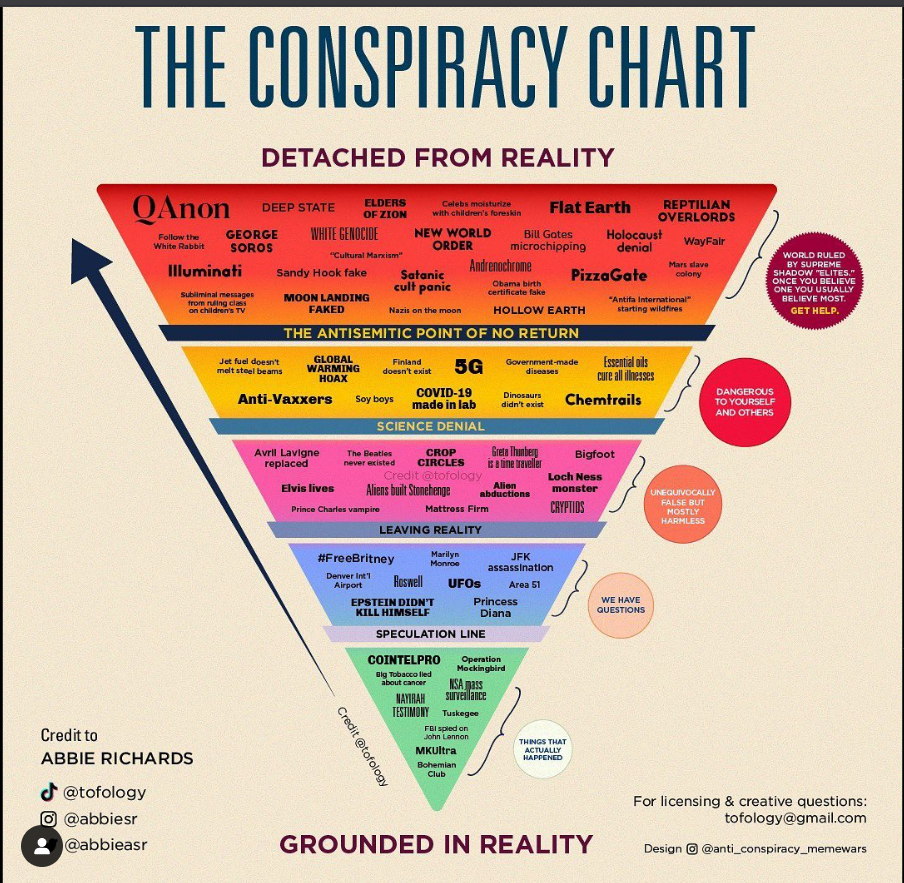
For instance, in October 2022, How2Inform received $147,707 from the DHS TVP program to “to establish and expand statewide media literacy initiatives,” seeking to establish media literacy resources for educators in all 102 counties in Illinois. How2inform’s recommended teaching material includes a “conspiracy chart” that categorizes concerns about the deep state (shorthand for unaccountable government bureaucrats) and the influence of progressive billionaires like George Soros alongside “flat earth” theory and “reptillian overlords.”
Director of National Intelligence Tulsi Gabbard declassified the Biden administration’s Strategic Implementation Plan for Countering Domestic Terrorism. The document details how funding “digital literacy programming to combat online disinformation” was a key priority for the administration for “countering domestic terrorism.” DHS, the Department of Education, the State Department, and the U.S. Agency for International Development (USAID) was tasked with leading the digital literacy effort.
DHS’s Center for Prevention Programs (CP3) in 2022 held a joint online forum with the Education Department focusing on improving digital literacy with groups such as NAMLE and the News Literacy Project, two major proponents of media literacy.
Media literacy is pushed at the international stage, with the United Nations Educational, Scientific, and Cultural Organization (UNESCO) backing the development of Media and Information Literacy programs. UNESCO has hosted events across the world, in countries such as Zimbabwe, Dominican Republic, and more, about using media information literacy (MIL) to combat alleged disinformation. UNESCO also pushed media literacy as a global solution to “COVID disinformation” as well as ”climate disinformation.”
Media literacy has been used by groups such as the Critical Media Project (CMP) to promote transgenderism and critical race theory. The California Department of Education has listed the SPLC’s Learning for Justice program, the ISD’s Be Internet Citizens program, and the Critical Media Project toolkit as “ready-made curricula.”