SUMMARY
- The UK government plans to ban under-16s from major social media platforms from 2027.
- The proposal relies on age-verification systems to determine who can access online services.
- Young people would lose access not only to entertainment, but also to online communities, educational resources, and digital public spaces.
- The most significant long-term consequence may be the continued growth of the infrastructure used to identify internet users, a Digital ID system that threatens anonymous online speech.
The UK government has announced plans to ban under-16s from accessing major social media platforms from 2027, in what would represent one of the most significant expansions of online age-verification requirements since the passage of the Online Safety Act.
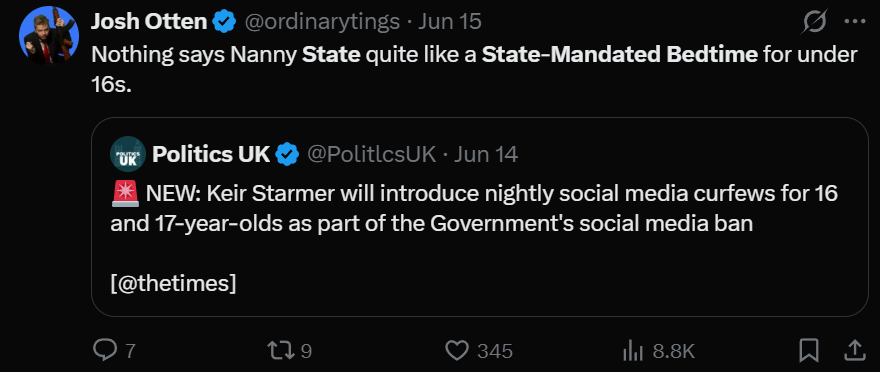
The proposal would apply to major platforms including TikTok, Instagram, Facebook, Snapchat, X, and YouTube. Ministers have presented the policy as a response to growing concerns about social media addiction, online harms, and children’s mental health. Alongside the social media ban, the government has also discussed restrictions on livestreaming, controls on who can contact children online, additional safeguards around AI-powered services, and how long kids can stay glued to their screens. The ban would also affect 16 and 17-year olds, who will face a nighttime curfew on social media use – a measure now being mocked on social media as “state-mandated bedtime.”
While the argument from proponents rests on ideas of “protecting our children,” the proposal risks restricting access to lawful speech, educational resources, and online communities while doing little to address the underlying causes of the problems it seeks to solve.
The most immediate question raised by the proposal is how it can be enforced.
A platform cannot reliably prevent under-16s from accessing its services unless it first has a reliable method of determining users’ ages. The government has therefore tasked Ofcom with examining age-assurance technologies and developing recommendations for implementation.
Several different approaches are currently available. These include passport checks, driving licence verification, digital identity providers, bank-account verification, and facial age-estimation systems. While the methods differ, they all depend upon the same principle: requiring internet users to prove their age before accessing online services.
This focus on age verification is not new. Age-restriction proposals first emerged during debates surrounding the Digital Economy Act in the mid-2010s, before expanding through the Online Harms agenda and eventually becoming a central component of the Online Safety Act. Each proposal differed in scope, but all relied upon the same basic principle: restricting access to online services by requiring users to prove their age.
However, there remains no widely accepted method of verifying the age of internet users that does not involve some degree of privacy trade-off, whether through identity documents, third-party verification services, financial information, or biometric analysis.
The effectiveness of the proposal also remains contested. Similar restrictions introduced elsewhere have prompted concerns about circumvention, with critics noting that VPNs, shared accounts, borrowed devices, and alternative platforms may undermine enforcement while still imposing privacy costs on compliant users. Even if age-verification systems function exactly as intended, questions remain about whether they can achieve the government’s objectives without creating significant unintended consequences.
The proposal also assumes that social media is primarily a source of risk rather than a source of value.
Interviews conducted with British teenagers following the government’s announcement suggest that many of the young people affected see things differently. Several questioned why older teenagers should be prohibited from using services that have become central to modern communication and social life. Others pointed out that 16- and 17-year-olds are trusted with a range of responsibilities in wider society, including employment and taxation, and even military service, yet may soon be prevented from accessing some of the world’s most widely used communications platforms.
Other interviewees highlighted the role social media plays in connecting people with communities and opportunities that may not exist offline. This was particularly relevant for young people in rural areas, those with specialist interests, and those seeking communities beyond their immediate geographic surroundings.
For many teenagers, social media has become woven into everyday social, educational, and civic life in a way that goes far beyond entertainment. Platforms are used to organise events, follow current affairs, develop interests, maintain friendships, and participate in communities that increasingly exist online as much as offline. A blanket ban therefore affects more than screen time. It also restricts access to a growing share of the social, cultural, and informational life that now takes place on digital platforms.
Decisions that were once made by families and individuals are increasingly being transferred to regulators and platform compliance systems. Each of these proposals depends upon the same underlying capability: the ability to determine a user’s age before access is granted.