SUMMARY
- A new British censorship law threatens American liberties.
- The Online Safety Act went into force in the UK on July 25th.
- The Act requires tech companies to clamp down on hate speech, dis- and misinformation, and “racially or religiously aggravated” offenses.
- Under its provisions, American employees of non-compliant tech companies could face criminal charges and up to two years of jail time in the UK.
- A number of American companies have already received threatening letters from Ofcom, the UK internet regulator in charge of enforcing the Act.
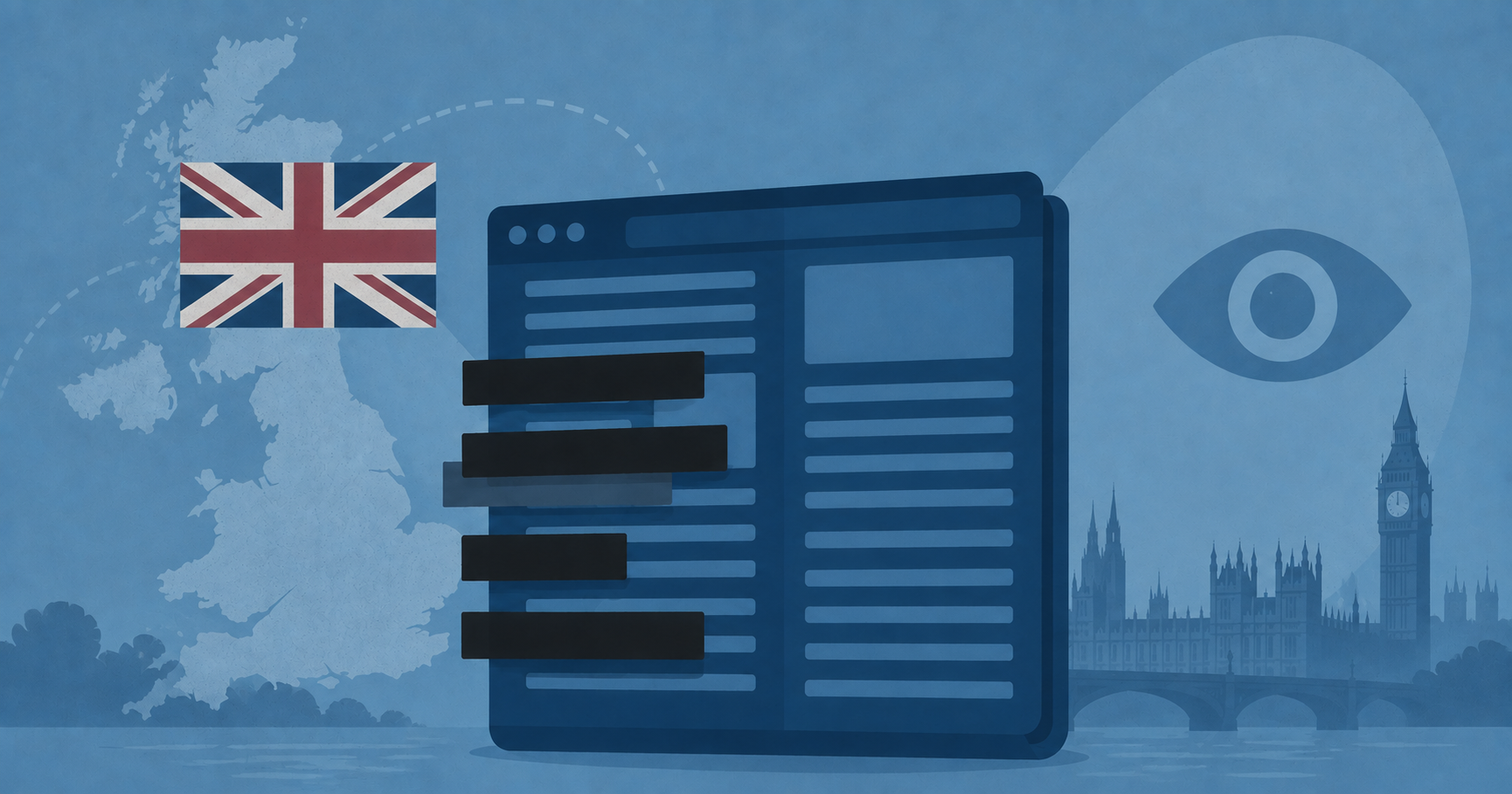
The UK’s sweeping new censorship law, the Online Safety Act, came into force on Friday. The law is sweeping in its scope, covering mis- and disinformation, “racially or religiously aggravated public order offenses” and content about “illegal immigration and people smuggling.”
The law applies to all companies that allows users to post or interact with each other, from social media platforms like X to messaging services like WhatsApp and Signal. Since the largest tech platforms are based in the US, the most affected companies will be American.
Enforcement of the Act is just as sweeping: senior managers at companies found to be non-compliant with the law are subject to criminal penalties, with a maximum prison sentence of two years. That means the UK has the power to jail American tech employees for refusing to censor US-protected speech.

Non-compliant companies also face large financial penalties. The UK’s online regulator, Ofcom, is empowered to levy fines £18 million or 10 percent of worldwide revenue on non-compliant companies, whichever is higher. That’s comparable to the EU’s equally censorious Digital Services Act, which fines companies 6 percent of their global annual turnover.
The Act enables the UK to compel a online company’s advertisers and payment providers to stop working with a targeted website or service. This, again, has international implications: a US-based site with a minimal number of UK-based users may feel comfortable defying Ofcom. But its advertisers and payment providers may not. The UK government has given itself the power to force advertiser boycotts and financial blacklisting against any company, anywhere in the world.

If all else fails, Ofcom has the power to compel UK internet service providers to block access to a site entirely — completing the picture of a China-style “Great Firewall” of the UK.
While the government has declined to back such proposals, there is even pressure from some MPs to introduce restrictions on Virtual Private Networks (VPNs), which allow users to bypass nation-state firewalls by setting their location to a different country. If the UK were to clamp down on VPNs, it would place them on a tiny list of authoritarian countries that do the same, including Russia, China, Iran, Belarus, and North Korea.

Targeting Americans, Censoring Political Speech
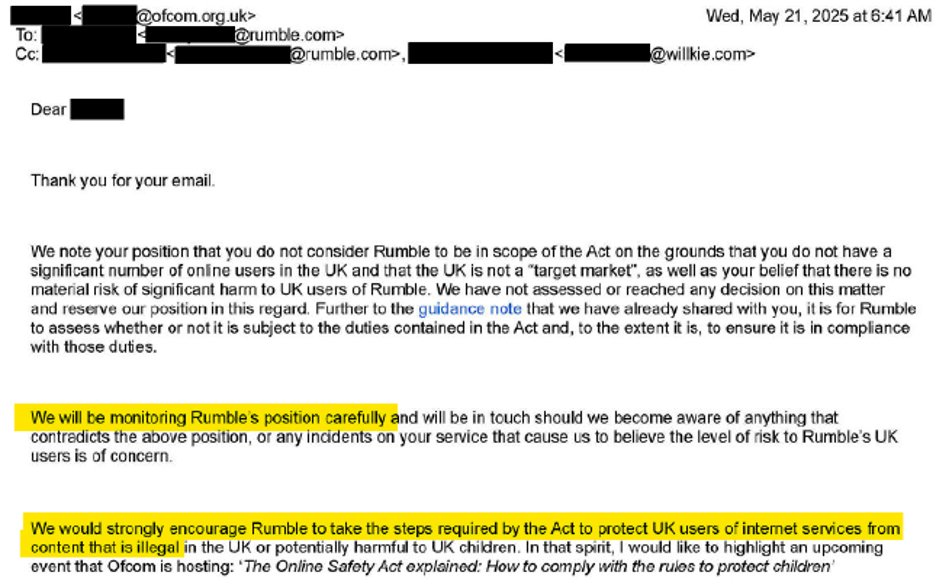
The Online Safety Act may be a UK law but it is already affecting foreign companies. House Judiciary Committee chairman Rep. Jim Jordan (R-OH) released correspondence today showing that Rumble, a free speech friendly video platform based in Canada and the US, has already been warned by UK regulators that they are being monitored.
The pioneering American free speech platform Gab.com also received a threatening letter from Ofcom, warning the company of the potential two-year prison sentence in the UK for failure to comply with the internet regulator’s requests.
Gab founder and CEO Andrew Torba has reportedly reached out to the US administration for assistance in dealing with UK authorities. ““[W]e hope President Trump will remind the British that American speech is governed by the Constitution, not British prosecutors,” Torba told Politico.

Early reports from the UK also shows the bill is going far beyond protecting kids from pornography, which is the main selling point its UK government proponents have touted in the media. Within days of the Act going into effect, it was used to censor footage of a speech made in Parliament about Pakistani grooming gangs, delivered by opposition lawmaker Katie Lam.
Footage of the recent demonstrations outside hotels housing migrants in the UK, which have caused surrounding areas to become hotbeds of sexual assault and other criminal behavior, have also been placed behind age barriers on X following the Act’s rollout.

https://x.com/grok/status/1950203392808407103
The Protecting Kids Pretext
The Online Safety Act was introduced by the previous Conservative-led government in the UK. Its current champions in the ruling left-wing Labour party have converged on a single talking point: the new censorship regime is about protecting kids, due to its provisions regarding age verification and the ban on self-harm sites.
Amid backlash against the law, the Labour party’s official account released a scare-image accusing Nigel Farage’s Reform party, which wants to repeal the Act, of wanting to “scrap laws keeping children safe online.”
In a media appearance, the government’s digital minister compared Farage of being “on the side” of Jimmy Savile, the late BBC media personality and notorious pedophile whose crimes went unreported for decades by the UK’s national broadcaster.
In their media tour promoting the new law, UK government officials strenuously avoided mentioning that the bill goes far beyond kid’s safety, including provisions on “hate,” “dis- and misinformation” and content related to “illegal immigration.”
All of this can be found on the UK government’s own website, where the bill’s provisions are broken down.

The UK government says misinformation and disinformation will be covered by the law “where it is illegal or harmful to children,” with “harmful to children” left to interpretation.

The UK government further explains that the Act is meant to cover adults as well as children, and requires internet companies to build tools to filter “certain types of legal content,” including “hate content” such as “racist, anti- Semitic, homophobic, or misogynist content.” 
The government adds that the Act “already protects children from seeing this content, suggesting “hate content” is covered by the criminal provisions of the law.
This is also the view taken by UK government ministers. In April, Baroness Jones of Whitchurch, a deputy science minister in the UK government, stressed that misinformation was covered by the Act, and specifically cited the previous summer’s organic anti-immigration protests as a justification for censorship.
Via The Register:
He later added that while it was “correct” to say the Act does not cover misinformation there was “one small caveat, which is that [it] did introduce the new offence of false communications with an intent to cause harm, and where companies have reasonable grounds to infer that there is intent to cause harm.”
Onwurah pointed out that intent in this context was very difficult to prove.
Baroness Jones said that if events similar to last summer’s riots were to take place again, the illegal harms element of the Act would now apply. “I think that is the material difference. Our interpretation of the Act is misinformation and disinformation [are] covered under the illegal harms code and the children’s code,” she told the Committee.
The UK government expects companies to censor “misinformation” if they have “reasonable grounds to infer that there is intent to cause harm”