SUMMARY
- Radicalized by the censorship industry, including former members of the Biden Administration, European states have become increasingly hostile to Silicon Valley companies.
- A €300 billion ($350 billion) blueprint, backed by the governments of France, Germany, and the EU’s Industry, Research, and Energy committee proposes that Europe replaces every part of the American tech stack, from infrastructure to AI companies.
- Separately, a project called “EuroSky” hopes to displace Elon Musk’s X with support from the EU.
- Creators of both the EuroStack blueprint and the EuroSky platform have justified their projects by pointing to the Trump Administration and Silicon Valley’s newfound reluctance to censor populist voices online.
Europe’s most ambitious bid for technological independence doubles as a roadmap for forcing American platforms out of the European market — and the same US-funded censorship industry that helped build the legal machinery is cheering it on.
A new buzzword has taken hold across think-tanks, policy experts, and talking heads in Europe: “digital sovereignty.” The term can be found repeated everywhere in European media segments, research institute publications, government memos, and even in the advertising materials of European tech companies. The concept envisages a Europe that is free from dependence on American tech platforms, with its own independent cloud, energy, data center, and connectivity infrastructure.
The most ambitious project is the EuroStack, a comprehensive blueprint for an independent European tech infrastructure published by Bertelsmann Stiftung, a major German policy institute, with support from the Institute for Innovation and Public Purpose at University College London and the Center for European Policy Studies in Brussels, Belgium.
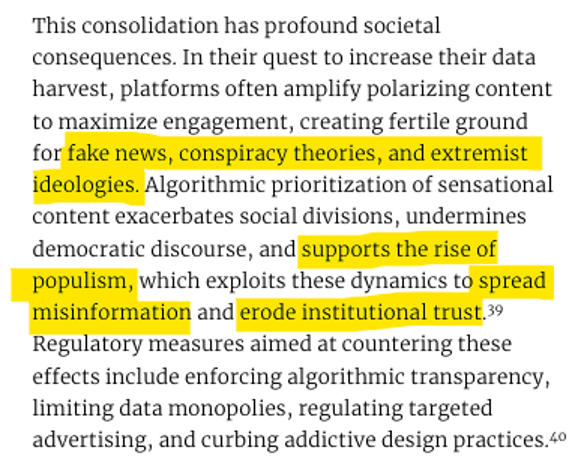
The authors claim American tech platforms “support the rise of populism” – even though they spent nearly half a decade censoring populists from their platforms, including President Trump. Simply returning to a level playing field, as has happened in the case of most platforms, is clearly unacceptable for the authors, who claim the American tech stacks fuels “fake news, conspiracy theories, and extremist ideologies.”
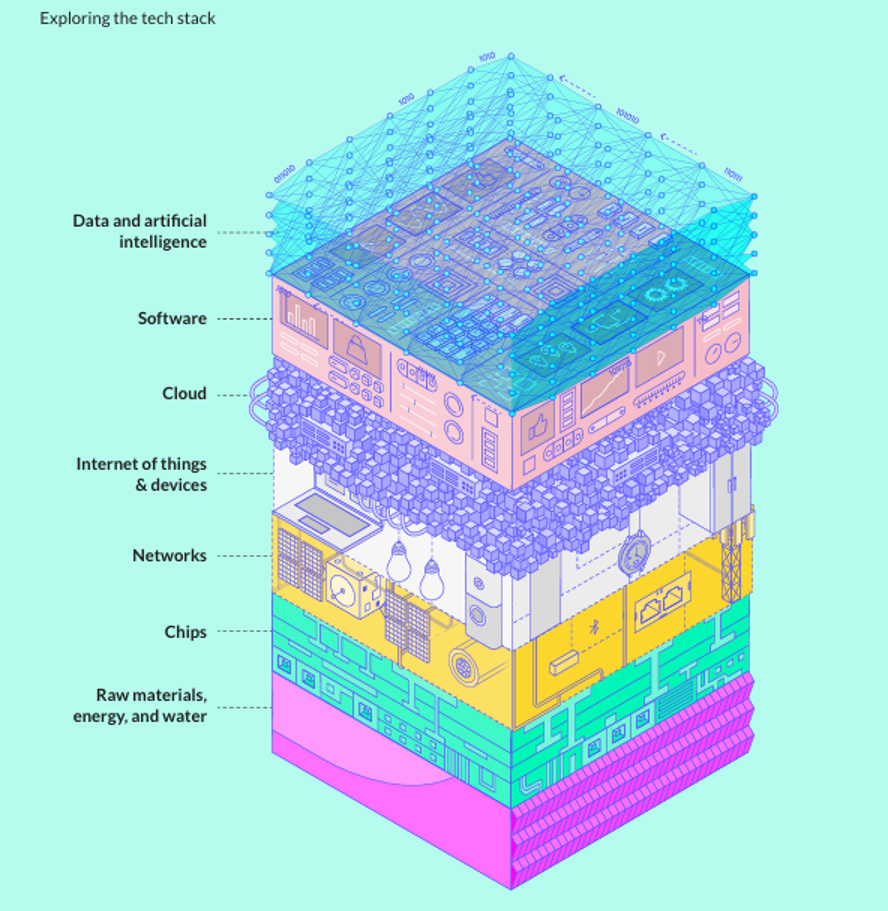
The EuroStack
To solve this, the authors imagine an independent “EuroStack” encompassing the entirety of the tech supply chain, from basic natural resources such as lithium and energy to power data centers at the bottom of the stack, to independent AI and data companies at the top of the stack.
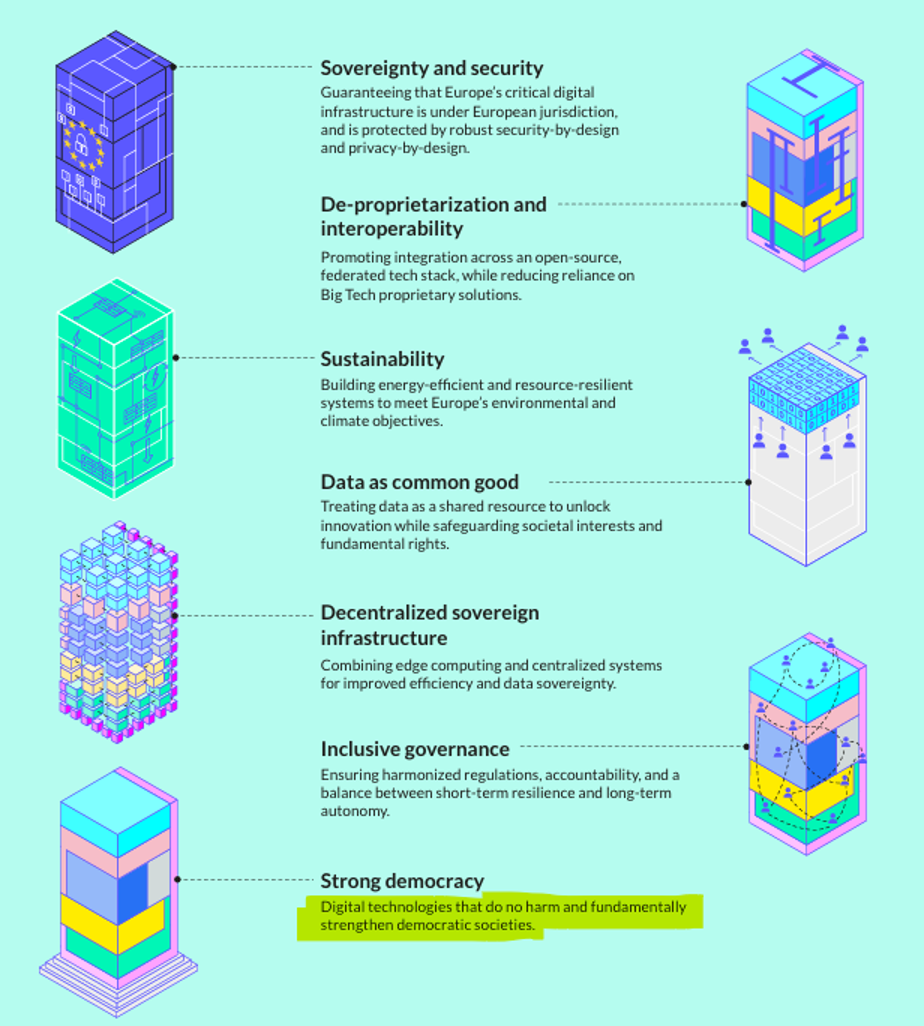
The goal is to create companies that “do no harm” and “fundamentally strengthen democratic societies” – presumably by suppressing the populist opposition, given the authors’ earlier objection to such movements gaining traction on social media.
The report’s lead author, Francesca Bria, was even more candid about her motivations in an article for Noema, the journal of the Los Angeles-based Berggruen Institute.
The EuroStack is needed, wrote Bria, to challenge what she perceives as the “crypto hyper-libertarianism and techno-authoritarianism” of the tech industry. In the essay, Bria set out the worldview driving the project – obsessive anger at some (but hardly all) Silicon Valley figures support for Donald Trump and right-of-center causes:
Silicon Valley’s Turn To Techno-Nationalism
What Silicon Valley presents as neutral technological progress is increasingly revealing itself as an authoritarian political project. Trump’s second administration has accelerated this transformation with breathtaking speed. The Pentagon now directly commissions tech executives into military ranks through programs like Detachment 201. Palantir’s $10 billion U.S. Army contract makes its surveillance systems the de facto operating system of the modern military, integrating battlefield intelligence with domestic data. Anduril’s autonomous weapons factories mass-produce AI-powered drones while its executives rotate into senior Pentagon positions.
The architects of this system no longer hide their vision. Palantir CEO Alex Karp’s manifesto “The Technological Republic” articulates “patriotic tech” as a kind of fusion of Silicon Valley libertarianism with authoritarian nationalism. This ideology, rooted in anti-democratic philosophies, casts technological supremacy as a civilizational imperative.
Alex Karp presents Palantir as a bulwark against “American decay,” Elon Musk unilaterally restricts Ukrainian access to Starlink based on his own political whims and Peter Thiel directs ideological allies into government, channeling U.S. venture capital and defense money into his causes. Every major AI lab now depends on people and institutions that are opposed to democratic governance. What is emerging is not a planetary commons but a new tech-military complex financed by capital aligned with authoritarian ideologies and legitimized through patriotic rhetoric.
When critics dismiss concerns about AI bias, surveillance capitalism and platform monopolization as ideological extremism, they reveal their own allegiance to this kind of oligarchic control. To brand all this critique as “Lysenkoism” or “woke Marxism” while ignoring the real risks of AI capture echoes Trump’s new McCarthyism against imagined threats.
This shows the ideological roots of the new push for European “digital sovereignty,” and the likely biases of the “EuroStack” should it ever come to fruition. There was no such demands for digital independence when American companies were dutifully censoring populists in both America and Europe. Now that parts of Silicon Valley – certainly not all of it – are entertaining different political values, the “digital sovereignty” movement suddenly appears.
In their blueprint, the authors of the EuroStack report claim that digital sovereignty is necessary to support digital technologies that “strengthen democratic societies.” The obvious subtext is that the relative rollback of censorship on platforms like X is somehow a threat to democracy.
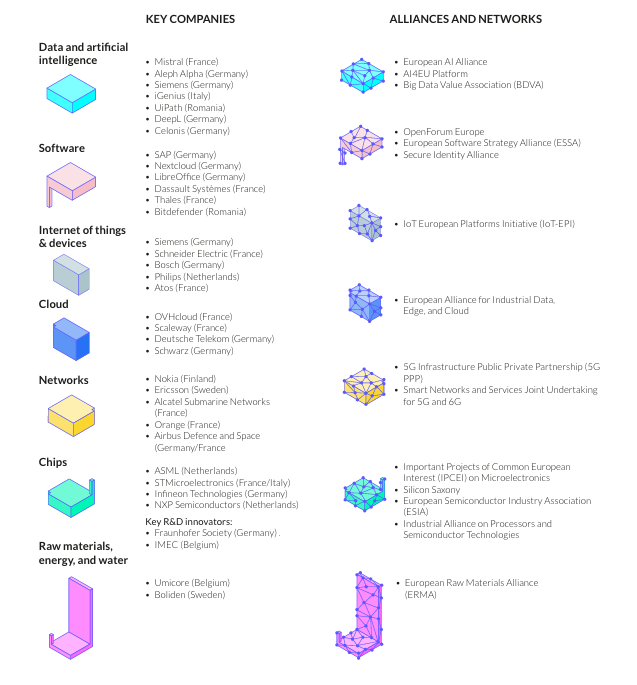
In the main EuroStack blueprint, the authors authors map out European companies that could be used as the basis for the EuroStack. Notably, some companies such as French telecoms giant Orange are already advertising themselves as the foundation of Europe’s digital sovereignty.
The central financial ask of governments is large and explicit: a transformation estimated to take roughly a decade and require investments of around €300 billion, with a proposed European Sovereign/Technological Sovereignty Fund as the vehicle.
The idea has already received substantial statements of support from European states and EU governing institutions. In June 2025 the proposal received the support of the European Parliament’s ITRE Committee (Industry, Research and Energy), and it has already been officially endorsed by France and Germany, the two most influential nations of the EU.
This makes EuroStack the leading vehicle for Europe-wide “digital sovereignty” efforts, by a considerable margin.
Replacing Social Media: The EuroSky Project
No American platform receives more ire than Elon Musk’s X, which led the way in reversing the censorship policies of the late 2010s and early 2020s, including the first unban of Donald Trump.
As FFO previously revealed, a project is underway to replace X in Europe, called “EuroSky.” Launched publicly in April 2026 and based in the Netherlands, EuroSky is not a consumer app in itself but a layer of social-media infrastructure, coordinated by the campaign group Free Our Feeds. Its architects include Robin Berjon, a former data strategist at The New York Times; Sherif Elsayed-Ali; and Sebastian Vogelsang, founder of the Bluesky-based photo-sharing app Flashes. EuroSky is built on the AT Protocol — the same open framework that underpins Bluesky.
EuroSky’s backers describe a roadmap toward what they call full independence from American platforms, and a central piece of that plan is a shared content-moderation system — a moderation “commons” that European apps could license rather than build themselves. In other words, the same infrastructure marketed as a guarantee of user control would also concentrate the power to decide what speech is permitted across an entire ecosystem of European apps.
Berjon sees widespread adoption of EuroSky as the first stage in a multi-step process to replace American tech companies with European ones. He also described a future in which state-run media companies like the BBC operate their own social media algorithms — restoring the power of traditional media gatekeepers over the flow of information.
“We need our own infrastructure. And the question is like, okay, let’s do infrastructure. The first thing that people go to is like, oh, are we going to have state run social media? That’s kind of terrifying. And also people are very worried that it’ll be uncool if nothing else. And there are multiple ways of running it.
There are many solutions. There are many sources of people who can run infrastructure. There’s of course states, and we have the public broadcaster model as a system. It doesn’t mean that you necessarily get only say, BBC recommendation engines, BBC content moderation, but you can run the infrastructure and allow people a lot of flexibility on top of that. That’s one model.”
Berjon further described the problem of “authoritarian” digital infrastructure providers producing an “authoritarian” society — apparently without irony, only minutes before suggesting the use of military force to shut down American tech platforms.
“Now, we’ve tended to forget that infrastructure is able to set rules because we’ve generally regulated infrastructure or providers such that they’re not allowed to set their own rules or only within very strict parameters. But we haven’t done that on the internet. And so because infrastructure set rules, if you have authoritarian infrastructure providers, you have an authoritarian society running on top of it. And that is the problem of sovereignty. So again, how do we fix this? What do we do about this? Well, there’s no way out other than producing and controlling our own infrastructure, replacing these systems with our own.”
Control, Destroy, or Replace
The current attitude of the censorship industry is that if American social media platforms cannot be controlled – that they must be destroyed or replaced. There seems to be no boundaries on the lengths they will go to achieve this – Berjon himself was even willing to entertain use of the military against American tech companies.
The formula for “destroy and replace” appears to be emerging. On the one hand, the EU and other jurisdictions will levy massive fines against American tech platforms. On the other, the EU will slowly build out the alternative digital infrastructure. When it’s ready, the EU will have the option to force American tech out of the European market altogether – perhaps by increasing fines to levels that make it financially untenable for them to remain.
Despite the language and objectives (“digital sovereignty”), the American side of the global censorship industry, and the previous administration, had much to do with the current state of affairs. FFO has documented how both the US International Trade Administration and a slew of US-funded NGOs played a central role in both crafting and implementing the same EU Digital Services Act that may soon be used to muscle American tech platforms out of the European market, to be replaced by government-censored alternatives.
After being rejected by voters in the 2024 election, the previous administration has continued to encourage foreign censorship against American platforms.
As FFO has previously shown, former Biden “counter-disinformation” czar Nina Jankowicz has encouraged European lawmakers to stand up to the “autocratic” United States, and told Canadian lawmakers she supports fining American tech platforms for carrying “hateful” speech.
For Jankowicz, and much of the American censorship industry, the zone of conflict is not national but ideological. It is not a matter of American companies versus European ones, but companies that agree to censor “hateful” content versus those that do not.
The censorship industry wishes to control or eliminate the latter, by any means necessary. If that means American tech companies – currently the lifeblood of the national economy – are displaced by European competitors, many members of the American censorship blob would likely see that as a necessary sacrifice.