For nearly a decade, the federal government has spent millions of taxpayer dollars supporting an ecosystem of universities, non-governmental organizations, contractors and research institutes dedicated to combating so-called “misinformation” and “disinformation.” While these programs were often presented as efforts to protect elections, public health or national security, they frequently operated by encouraging, facilitating or coordinating the suppression of lawful online speech.
Now, Congress is attempting to shut off that funding.
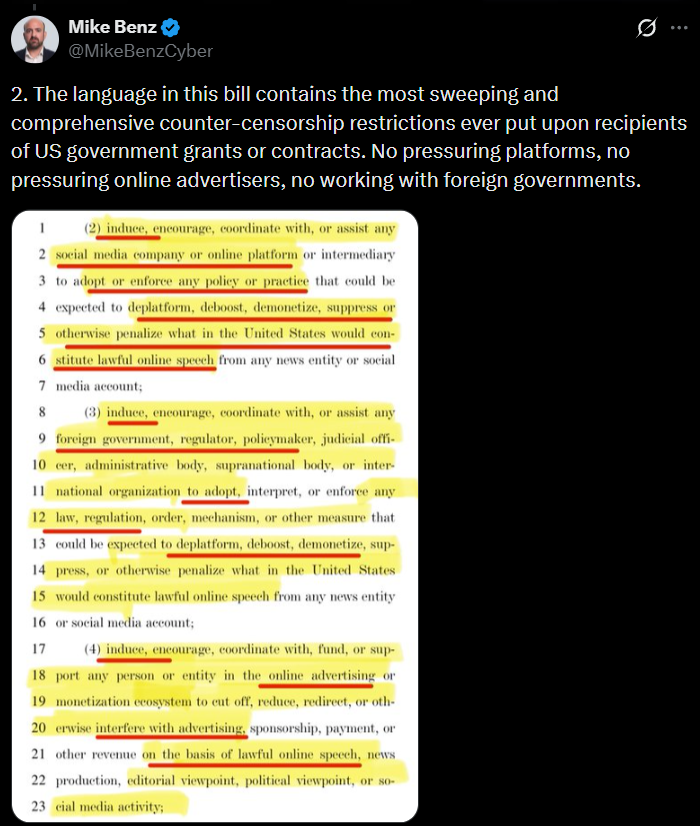
The House is considering H.R. 8595, the National Security, Department of State, and Related Programs Appropriations Act for Fiscal Year 2027. Buried within the appropriations language are provisions that would prohibit recipients of State Department funding from using taxpayer money to participate in a broad range of censorship activities.
Rather than regulating social media companies themselves, the legislation attacks the financial infrastructure that has underpinned much of the modern censorship industry. Universities, NGOs, contractors and other grant recipients would be required to choose between accepting federal funding and participating in censorship-related programs.
Among other things, the legislation would:
- Prohibit recipients of State Department funding from using federal funds to pressure or encourage online platforms to suppress lawful speech.
- Ban federally funded organizations from conducting censorship initiatives under labels including “misinformation,” “disinformation,” “hate speech,” or “brand safety.”
- Prevent taxpayer funds from supporting foreign governments or international initiatives that seek to censor speech on American online platforms.
- Extend these restrictions to contractors, subcontractors and intermediary organizations receiving covered appropriations.
- Require additional congressional oversight and reporting to ensure compliance with the new restrictions.
Supporters argue these provisions are designed to prevent a repeat of the public-private censorship networks that expanded dramatically during the 2020 election cycle and the COVID-19 pandemic.
Rather than censoring speech directly, federal agencies increasingly partnered with outside organizations that claimed to be independent researchers or civil society groups. These organizations would identify supposedly problematic content, produce reports on emerging narratives, or act as clearinghouses through which government officials, academics and technology companies exchanged information about speech they believed warranted moderation.
The provisions target an ecosystem that has grown significantly over the past several years through federal grants, research programs and public-private partnerships.
Perhaps the best-known example was the Election Integrity Partnership, a coalition led by Stanford University that worked with election officials, government agencies and major technology platforms during the 2020 election to identify and report online content it considered election misinformation. Internal documents showed extensive coordination between government agencies, researchers and social media companies over content moderation. The partnership created an indirect mechanism through which government-backed actors could influence the moderation of lawful speech without issuing censorship orders directly.
The Foundation for Freedom Online has also documented the role of federally funded organisations including the Wilson Center and the Center for Democracy & Technology. The Wilson Center has received government funding for initiatives such as sponsoring developers to create a video game for children that pitted “superhero” governments, industry partners, and legacy media companies against disinformation, while the Center for Democracy & Technology, a supposedly non-partisan group, has been a prominent advocate of platform content moderation policies and has worked closely with federal agencies on issues ranging from election integrity to online harms. Together with dozens of universities, think tanks and NGOs, these organisations formed part of a censorship industry: an interconnected network that developed, promoted and coordinated online speech governance while operating at arm’s length from the government itself.
Former NED Officer Admitted ‘Counter Disinfo’ Efforts Were Response to Trump
Beyond these examples, there was an even wider roster of organizations on State Department or other federal funding streams. Chief among them is the Global Disinformation Index, a British group whose American affiliates — the Disinformation Index Foundation and Disinformation Index Inc. received support routed through the State Department-created and funded “Disinfo Cloud”, and which compiled advertiser “exclusion lists” that critics say were used to demonetise conservative-leaning outlets; the Daily Wire and the Federalist have sued the State Department over the alleged targeting of their reporting.
NewsGuard Strategy Revealed: Financial Throttling, Virality Suppression, Institutional Partnerships
NewsGuard, an American outlet-rating firm, was likewise tied to the government through a Global Engagement Center/Department of Defense split award. The Global Engagement Center itself sat at the centre of this apparatus — directly funding GDI and NewsGuard, supporting their development through its testbed, and encouraging the private sector to adopt these services through public endorsements and industry liaisons — before Congress declined to continue funding it and the State Department shuttered the office. The State Department-financed National Endowment for Democracy was also drawn in: the NED, which has received hundreds of millions in taxpayer dollars from the State Department, contributed to GDI’s budget before announcing in 2023 that it would no longer fund the group.