SUMMARY
- Newly released messages show Anthony Fauci, Vivek Murthy and Rochelle Walensky privately discussing concerns and uncertainties surrounding COVID vaccination during pregnancy in January 2021.
- At almost the same time, senior Biden White House officials began pressuring Facebook and other technology companies to take increasingly aggressive action against COVID and vaccine-related speech.
- Jeff Zients, Biden’s COVID-19 Response Coordinator and a former Facebook board member, sat at the top of the White House pandemic operation, while advisers Andy Slavitt and Rob Flaherty left an extensive documentary record of direct pressure on social media companies.
- Internal Facebook communications show the White House pushed for action against vaccine scepticism, satire, personal stories that Facebook acknowledged were often true, and material that did not violate existing platform rules.
- Years of litigation, congressional subpoenas and FFO investigations have since exposed the wider machinery through which government officials, technology companies and private organisations sought to control online COVID speech.
In January 2021, Fauci, incoming CDC Director Rochelle Walensky and future Surgeon General Vivek Murthy were privately discussing questions and concerns they had heard surrounding COVID vaccination during pregnancy.
Murthy told Fauci that he had been “hearing the concern about the mRNA causing mutations in the developing fetus as well.” In another exchange, Fauci raised a separate theoretical concern that the inflammatory response and fever experienced by some people following a second vaccine dose “could be associated with miscarriage in the 1st trimester.”
The messages were among the first batch released this month by Senators Ron Johnson and Rand Paul from more than 34,000 messages recovered from Fauci’s former government-issued phone. So while the government’s most senior public-health officials were themselves privately discussing uncertainty, theoretical risks and claims that they were hearing about a newly developed vaccine, officials inside Joe Biden’s White House were beginning an extraordinary campaign to pressure America’s largest technology companies over what ordinary people were allowed to say about COVID and the vaccines. Because, while Fauci and Murthy were able to discuss concerns with the vaccine and pregnancy, the Biden administration was sending emails daily to Facebook with demands to censor posts that raised those same concerns.
Over the following months, officials demanded explanations for posts they disliked, questioned why content had not been deleted, pressed platforms to rewrite their moderation policies, complained about vaccine skepticism and pushed for the suppression of material which the platforms themselves acknowledged was sometimes true.
When Joe Biden entered office, he appointed Zients as White House COVID-19 Response Coordinator putting him in charge of coordinating the administration’s pandemic response across the federal government. That response was to “coerce Big Tech by linking moderation to regulatory or legal consequences,” and urging and directing them to “impose viewpoint based censorship.”
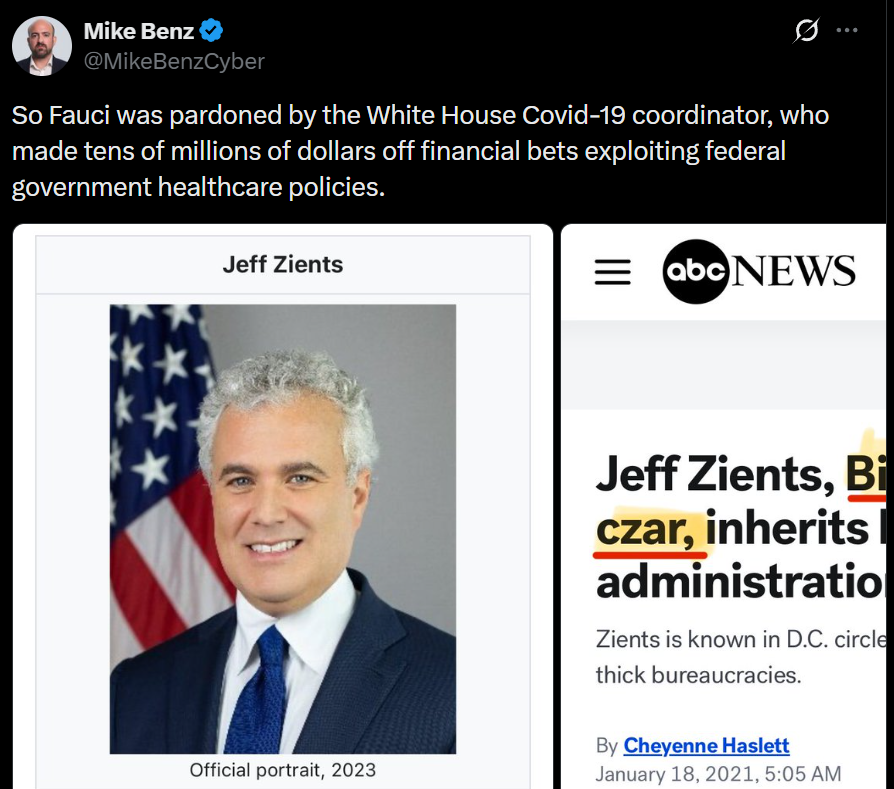
Zients also had an unusually close connection to one of the companies the administration was about to pressure. In 2018, Facebook announced that Zients had joined its board of directors and audit committee. He remained on the board until 2020, shortly before joining the Biden administration.
On Biden’s final day in office, Fauci received a sweeping pre-emptive pardon covering conduct dating back to 2014. Subsequent congressional investigation established that not only did Zients directly authorize the use of Biden’s autopen for last-minute pardons (after aides conveyed presidential approval), but that Zients was one of the senior officials leading the push for pre-emptive pardon deliberations in 2024. As FFO Executive Director Mike Benz noted, “the guy who actually pardoned Fauci was the same guy who got you censored for questioning Fauci.”
However, some of the clearest documentary evidence of Biden-era social media pressure comes from the officials working beneath and alongside him. One of the most aggressive was Andy Slavitt, Zients’s senior adviser on the White House COVID response.
Slavitt dealt directly with Facebook executives as the administration became increasingly dissatisfied with the company’s treatment of vaccine-related content. According to records later reproduced in Murthy v. Missouri, Slavitt complained that Facebook was not sufficiently straightforward in its dealings with the administration and told the company that the White House did not believe it was genuinely attempting to solve the “misinformation” problem.
He then issued a warning. “Internally we have been considering our options on what to do about it,” Slavitt told Facebook. Facebook told the White House that it “obviously” had work to do to regain its trust and subsequently promised Slavitt and other officials additional measures to reduce the spread of vaccine material.
Slavitt’s attention was not limited to objectively fabricated medical claims. Internal records showed him asking Facebook what it was doing about vaccine skepticism while the administration repeatedly pressed the company to take action against the so-called “Disinformation Dozen,” a group of vaccine critics accused of driving a large portion of vaccine misinformation online.
In another exchange, Facebook’s Nick Clegg described Slavitt as “outraged” after the company refused to remove a post comparing vaccines with asbestos poisoning because the content did not violate its policies. Clegg told Slavitt that removing such material would represent a significant expansion beyond Facebook’s traditional boundaries of free expression. Slavitt’s concern, according to Clegg’s account, was that such speech could undermine confidence in vaccination.
If Slavitt provided the pressure from the White House COVID operation, Rob Flaherty produced perhaps its most extensive paper trail. Flaherty served as Biden’s Director of Digital Strategy and communicated repeatedly with Facebook, Twitter and YouTube over their moderation practices.
The Supreme Court’s description of the Murthy record says White House officials “peppered Facebook” with detailed questions, pushed the company to suppress particular content and sometimes recommended changes to its policies.
Flaherty was frequently the official doing the peppering. After reading research suggesting Facebook contributed to vaccine hesitancy, Flaherty emailed the company under the subject line: “You are hiding the ball.” The White House, he told Facebook, was “gravely concerned” that the platform was one of the leading drivers of vaccine hesitancy. “We want to know that you’re trying,” he wrote. “We want to know how we can help, and we want to know that you’re not playing a shell game with us when we ask you what is going on.” Facebook responded by offering additional measures.
Among the categories subsequently discussed were personal stories about negative vaccine experiences. According to the record highlighted by Justice Samuel Alito in his Murthy dissent, Facebook acknowledged that such personal accounts were “often true.” The fact that a claim might be true did not necessarily protect it from reduced circulation.
Flaherty also repeatedly challenged Facebook over individual posts. When the White House discovered that a Tucker Carlson video questioning the efficacy of the Johnson & Johnson vaccine had become one of Facebook’s most-viewed vaccine posts, the company explained that the video did not qualify for removal under its policies and would instead be demoted. Flaherty demanded to know why.
“How was this not violative?” he asked. “What exactly is the rule for removal vs demoting?” When Facebook failed to reply quickly enough, Flaherty followed up: “These questions weren’t rhetorical.” He also invoked the January 6 Capitol riot while complaining about Facebook’s moderation decisions. “Not for nothing but last time we did this dance, it ended in an insurrection,” Flaherty wrote. According to the court record, Flaherty told Facebook that he was reporting on the misinformation issue directly to the President.
The pressure was not confined to Facebook. White House communications with YouTube similarly focused on content that remained online despite not violating the company’s existing rules. In one internal summary of conversations with Flaherty, Google employees recorded that what particularly interested him was what YouTube was seeing that was “NOT coming down.”
YouTube repeatedly received questions about why certain vaccine content remained online. In September 2021, as the company prepared a broader vaccine misinformation policy, it contacted the White House to preview the proposal and solicit feedback before its announcement.
Amazon received even more direct attention from Slavitt also. In March 2021, Slavitt contacted the company over what he described as high levels of vaccine “propaganda,” misinformation and disinformation available through its marketplace. Internal Amazon correspondence subsequently asked whether the administration wanted books removed outright, suppressed in search results, or both. The company then introduced additional measures affecting the promotion of anti-vaccine books.
The administration’s interest therefore stretched beyond enforcing the platforms’ own policies. It extended to persuading the platforms to change where those boundaries were drawn. Justice Alito, joined by Justices Clarence Thomas and Neil Gorsuch, would later describe this relationship in stark terms.
His dissent accused White House officials of engaging in “constant haranguing” and issuing dozens of demands for compliance while alluding to potentially adverse consequences for platforms that refused. In his view, the record revealed “a scheme of state censorship.”
Vivek Murthy provides perhaps the clearest bridge back to this week’s Fauci revelations. In January 2021, Murthy was privately discussing the concerns he was hearing about mRNA vaccination during pregnancy. By July, as Surgeon General, he had become one of the administration’s most prominent public voices against online health “misinformation.” Murthy issued a Surgeon General’s advisory describing health misinformation as an urgent threat and calling on technology companies to redesign products, address misinformation “super-spreaders” and impose consequences on repeat offenders.
The White House simultaneously escalated its own rhetoric. Press Secretary Jen Psaki publicly acknowledged that the administration was flagging “problematic posts for Facebook that spread disinformation.” She also argued that somebody banned from one platform for COVID misinformation should be banned from others. Biden then accused Facebook of “killing people.”
The officials themselves were allowed, indeed required, to operate in a world of changing evidence, incomplete knowledge, theoretical risks and disputed claims. The public sphere was increasingly being subjected to a different standard.
DHS Encouraged Children To Report Family To Facebook For Challenging US Government Covid Claims
As the FFO has documented repeatedly, the White House pressure campaign formed only one part of the COVID-era censorship ecosystem. FFO previously revealed DHS educational material depicting a child reporting a family member to Facebook for challenging government COVID claims, while other reporting exposed federal involvement with Google in developing a professional “infodemic” workforce dedicated to combating online misinformation.
Further documents obtained by FFO showed CDC personnel continuing to prioritize misinformation messaging around vaccine safety questions, while FFO also documented how advertising giant Publicis Groupe, whose clients included major pharmaceutical companies, helped fund NewsGuard and later partnered with it on health-focused blacklisting and ratings products during the pandemic.
Government agencies, social media platforms, academic and nonprofit misinformation organizations and the advertising industry increasingly developed overlapping mechanisms capable of restricting the visibility or financial viability of disfavored speech.
In 2026, the federal government began settling some of the major cases produced by the Biden-era censorship program. In March, the Justice Department settled litigation stemming from Missouri v. Biden and a related Children’s Health Defense case. The agreements imposed restrictions designed to prevent several federal entities from coercing or significantly encouraging social media companies to suppress protected speech.
Attorney General Pam Bondi characterized the previous administration’s actions directly, saying the Biden administration had “coerced social media companies to stifle free speech that they disapproved of.”
Two months later came another. The Justice Department settled journalist Alex Berenson’s lawsuit alleging that Biden administration officials had induced Twitter to suppress his COVID-related speech.
The Department described the case as challenging alleged government coercion and censorship and stated that coercing a social media company into suppressing disfavored speech would violate the First Amendment.
US Government Concedes First Amendment Violation in Berenson Settlement
Biden White House officials repeatedly contacted technology companies about COVID speech. They demanded explanations for moderation decisions. They asked for additional censorship. They pushed companies to alter policies. They complained about speech that did not qualify for removal. They sought action against vaccine skepticism, jokes and personal experiences. And the companies repeatedly responded by promising the White House that they would do more.