SUMMARY
- Clean Up the Internet was founded to combat anonymous trolling, misinformation and what it called the deterioration of online discourse.
- The group was launched by an experienced regulatory lawyer, supported by a foundation he helped govern, and advised by figures from law, campaigning, academia and technology policy.
- Its political supporters repeatedly cited abuse, mockery and criticism directed at MPs, with the group’s founder describing identity verification as providing “the freedom not to be shouted at.”
- Clean Up the Internet helped develop the verification model later incorporated into the Online Safety Act.
Its proposals would leave anonymity formally legal while allowing unverified users to be marked, filtered, treated as less credible and given fewer practical advantages. - The organization openly argues that social-media verification could accelerate wider adoption of digital-identity products.
A global push is underway to make internet users prove their age or identity before accessing online services. In Europe, governments are connecting age checks to emerging digital-identity systems, while American lawmakers are pursuing verification at platform and even operating-system level.
These measures are usually presented as child-protection policies, intended to keep minors away from harmful content and addictive platform features.
But one British campaign group offers a clearer view of another constituency behind the attack on online anonymity: politicians and public figures who are tired of anonymous “trolls.”
Clean Up the Internet was founded in 2019 to address what it called the “degradation in online discourse.” It blamed anonymous and fake accounts for trolling, intimidation, misinformation and the erosion of civil political debate. Its supporters complained that anonymity allowed people to abuse MPs, spread “dangerous falsehoods,” discourage others from entering Parliament and behave without “courtesy” or “good manners.” By 2021, its founder Stephen Kinsella was already giving evidence to Parliament.
In his comments to Parliament, Kinsella described his objective as “raising the level of discourse online,” drawing attention to what he portrayed as a large amount of “online abuse” on social media, warning that “racist abuse” online leads to “hate incidents” in the real world.
Yes, very much. Building on what Seyi and Andrew had to say, they have obviously talked about the particular abuse that is received by women and children. Opinium did some polling for Compassion in Politics and that showed that a quarter of all social media users right across the across the pitch have received abuse. As Andy said, this has got worse during lockdown. Some research came out yesterday from an organisation called Ditch the Label, which said that since 2019, online abuse has gone up by about 28%. It is still working on this, but it also remarked that this is not just an online problem, because we can see a correlation between, for instance, racist abuse online and hate incidents out in the street. So I am afraid that this is something that bleeds across from the online experience into the real world, if we want to call it that.
He also described his goal: to create a two-tier internet in which verified users have the right to block non-verified users:
Our proposal is not that we should ban anonymous accounts; it is actually that we should go back to where we thought we were starting with this Bill which is that we were going to take a design-led approach. We should say “Well, what is it about the design of these platforms that makes anonymous abuse and disinformation so problematic?” And we would say, “Rather than try to prevent people being anonymous”—I do not think we should; there are very many good reasons why people should want to be anonymous online—“why shouldn’t all of us have the right to be verified if we want to be verified?” It would then be clear to see. Perhaps Twitter’s tick is a good model. It should be clear to us which other accounts are verified, and then we could all be given the right to block interactions with all unverified accounts. Give control back to the individual user to curate their experience. In that way, those of us who felt vulnerable to anonymous abuse could screen it out by category, rather than having to block individual accounts as and when they abuse us.
Its a panel debating the topic of whether online anonymity should be abolished altogether, Kinsella described his goal as “the freedom not to be shouted at.”
Clean Up the Internet developed a system allowing verified users to identify and filter out everyone who remained unverified—a model parliamentarians later credited with influencing the Online Safety Act. The organization now argues that social-media verification could “drive take-up of digital identity products” and accelerate Britain’s wider digital-identity ecosystem.
Its campaign shows how complaints about political “trolling” can be transformed into identity infrastructure affecting every internet user.
Who is Clean Up the Internet?
Clean Up the Internet is a small, professionally organised lobbying group founded in 2019.
Its founder, Stephen Kinsella, is a veteran EU competition lawyer who previously led antitrust practices at Sidley and Herbert Smith. He is now a senior adviser at the global public-affairs consultancy APCO Worldwide, having joined in June.
The group’s co-founder, Robert McLeod, founded the regulatory news service MLex before joining APCO in 2025 as head of its European Competition and M&A practice, with the two co-founders now working at the same firm.
Clean Up the Internet’s lead consultant, David Babbs, was previously the founding executive director of 38 Degrees, the left-wing digital campaigning organisation. According to the group, he is responsible for producing its “strategy, research, and campaigns.” Its legal adviser, Raoul Stewardson, focuses on EU regulation and describes his role as campaigning against harms attributed to “fake and anonymous accounts.”
Kinsella has also co-founded Law for Change, a philanthropic fund that finances public-interest litigation intended to enforce or change law and public policy.
Clean Up the Internet’s advisory board draws heavily from the online-regulation ecosystem. Members have included figures from Demos, Foxglove, the Royal Society, Unchecked UK, ResPublica and Loughborough University’s Online Civic Culture Centre.
Kinsella’s founding statement made the group’s original grievance clear.
Going online had become a “wearing experience,” he wrote, because strangers could “pile in and disrupt” conversations. He suggested that the right to anonymity might sometimes need to be “restricted or conditioned,” arguing that anonymous accounts could “barge into the conversations of others and disrupt or effectively shut down those conversations.”
If platforms would not cooperate voluntarily, Kinsella said, the group was prepared to campaign for legislation.
Clean Up the Internet was therefore a founder-backed policy operation whose stated aim was to restrict the ability of anonymous strangers to disrupt online debate.
MPs against the “trolls”
Clean Up the Internet found an eager audience among politicians already furious with anonymous users.
Co-founder Robert McLeod argued that anonymity caused civilised discussion to “fall apart,” insisting that anyone entering the “cut and thrust of debate” should “have the courage to stand behind what we say and what we believe.”
Conservative MP Siobhan Baillie became the group’s leading parliamentary champion. Opening a Commons debate on anonymity in March 2021, she said that “cowardly keyboard warriors stalk these streets and lurk in our phones.” She described the internet as a network of “dark cyber streets and alleyways” and declared that “anonymity provides the shadows where these people can hide. It facilitates and encourages online abuse.”
Baillie complained that anonymous accounts attacked people’s “looks, weight, age, race, gender, disability, success as well as failure,” and described social media as a “toxic, unsafe hellhole.” She also condemned posts that possessed “the veneer of a justified challenge” but were, in her view, attempts to provoke “pile-ons and hate.”
She later warned that unless anonymity was tackled, “the horror, the suicides, the bullying, the racism, the misogyny, the people being put off becoming MPs, will continue unchecked.”
Conservative party MP Andrew Griffith went further, endorsing a proposal to “end online anonymity” and arguing that “no one has a right to a cloak to conceal their actions of harm.” Carla Lockhart described anonymous abuse as “part of daily life for most roles in public life” and compared the internet to “a large public space with an antisocial behavior problem.” She said technology companies should be forced to identify “online trolls” and cooperate with law enforcement.
Taiwo Owatemi told Parliament that “I doubt any of us in this place have not been subject to online abuse from some anonymous source.” She concluded that “there can be no accountability in anonymity,” and argued that social media could no longer continue without “some form of verification.”
Stella Creasy framed the issue as a conflict between the speech rights of anonymous users and those of the people they criticized, arguing that “the right to anonymity in what someone says has to be balanced against the right of the people they abuse to speak freely themselves.” She said anonymous speakers could make other people’s speech “less free.”
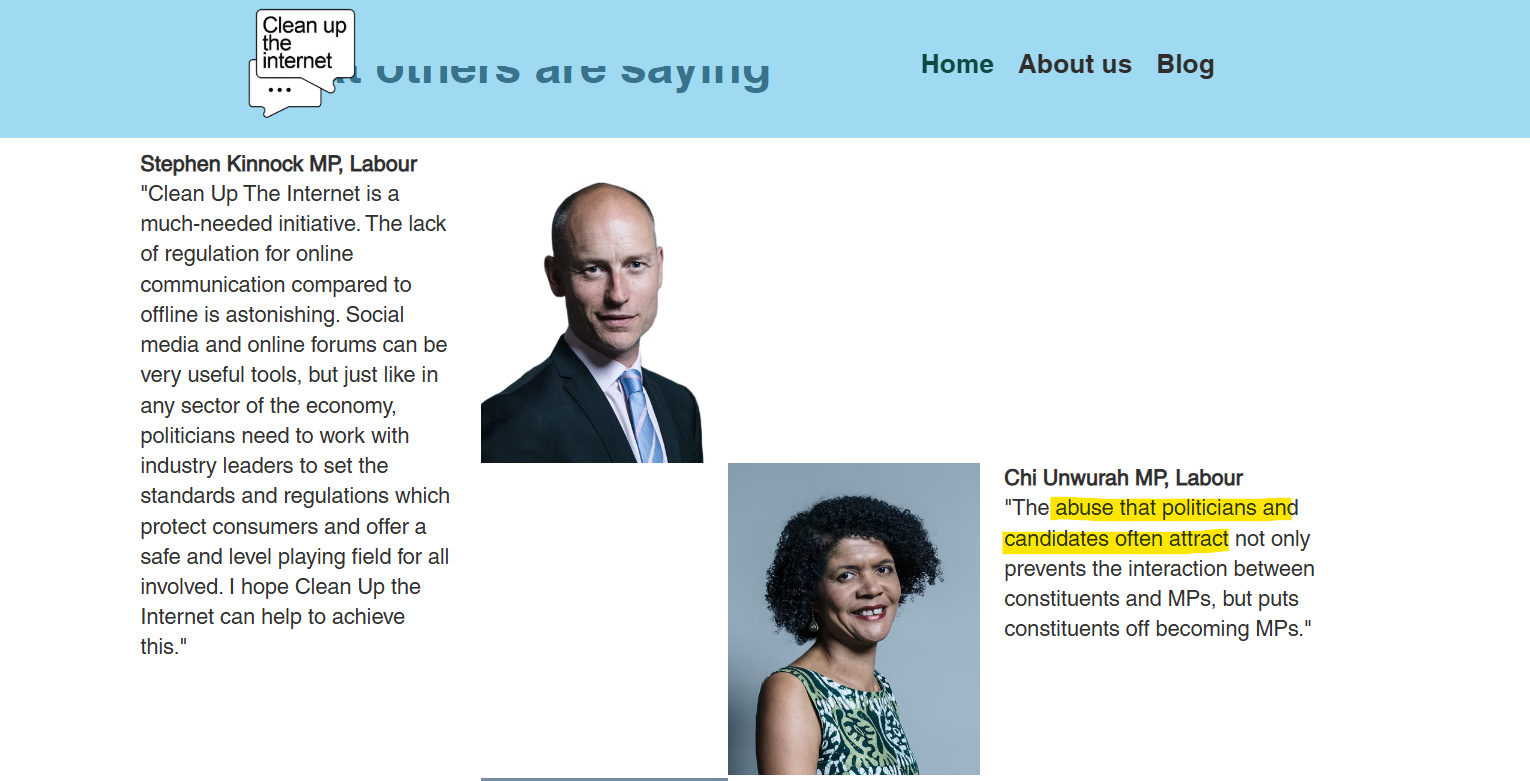
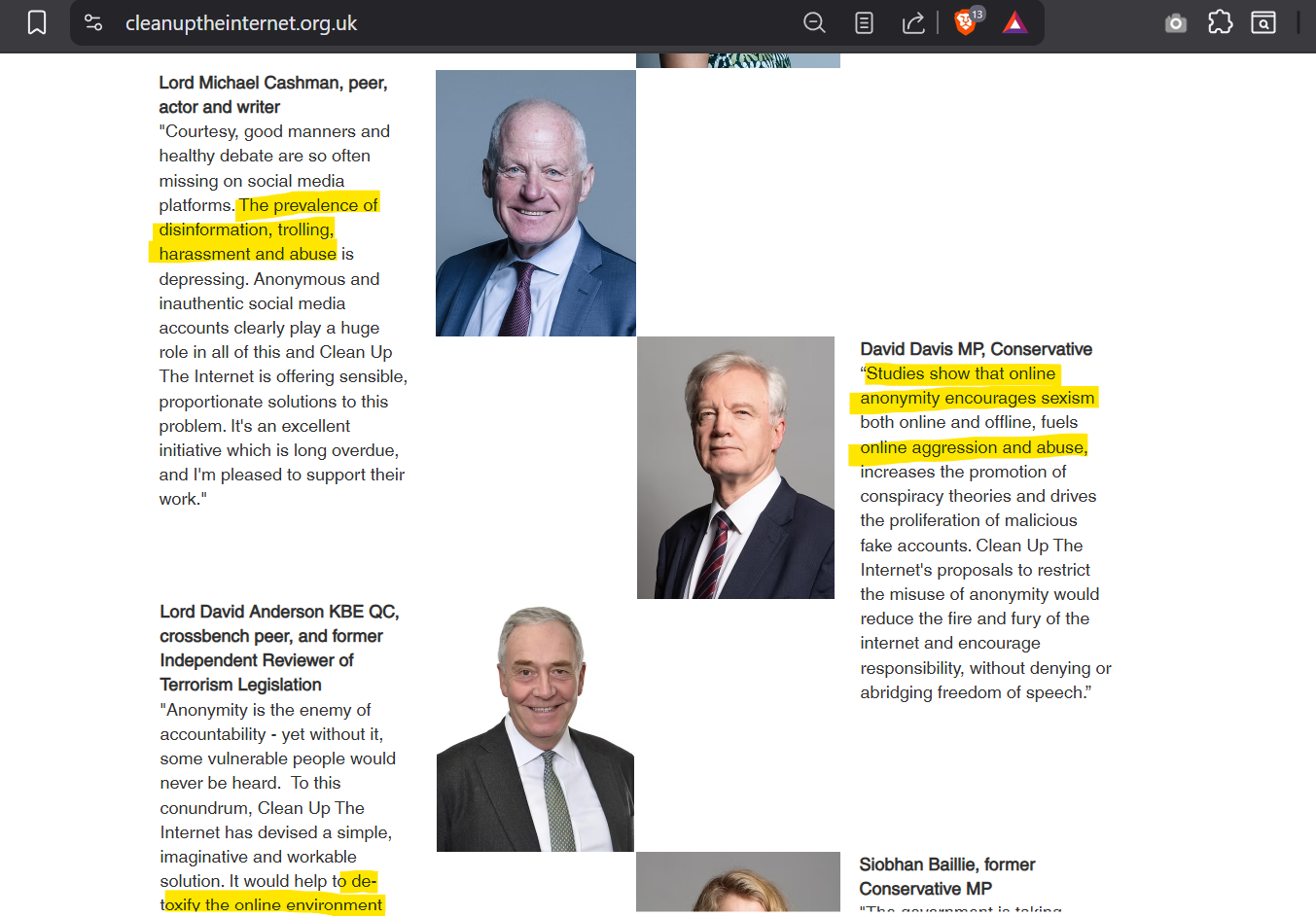
Clean Up the Internet’s own homepage offered more endorsements in the same vein. Labour MP Chi Onwurah complained that abuse directed at politicians and candidates deterred constituents from becoming MPs. Former SNP MP John Nicolson accused platforms of making life easy for “trolls, bullies, and spreaders of dangerous falsehoods.” Labour peer Lord Michael Cashman lamented the disappearance of “courtesy, good manners and healthy debate,” while David Davis said anonymity fueled aggression and malicious accounts.
The group acknowledged that this political support arose partly from MPs’ own experiences, stating that “cross-party support for action on this issue stems both from MPs’ awareness of the experiences and concerns of their constituents, and from them and their staff’s own experiences on social media.”
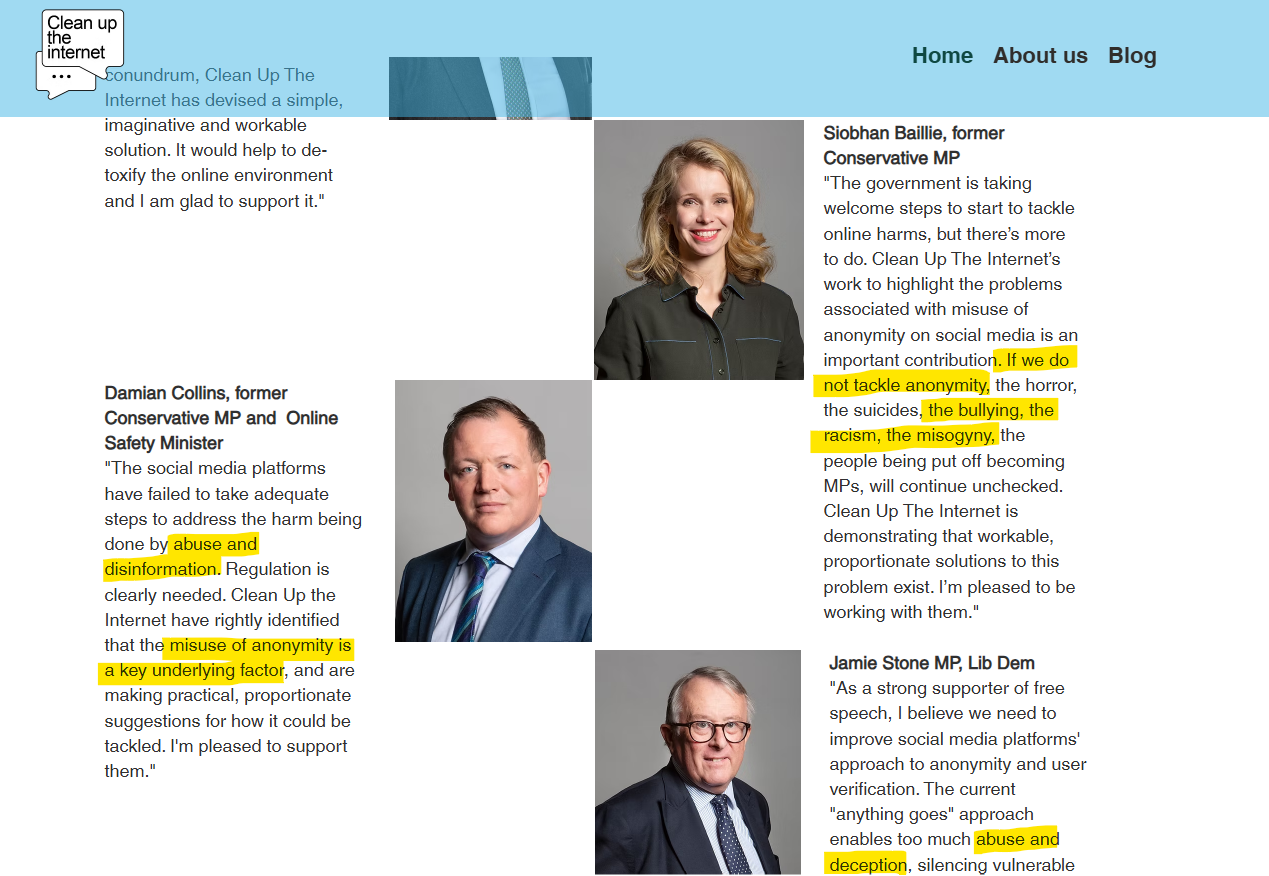
MPs repeatedly placed serious incidents of death threats, stalking, fraud and sexual harassment, alongside insults, misinformation, mockery, pile-ons, bad manners and aggressive political disagreement.
Far from child safety, which government ministers trumpeted in the media as the main justification for the Online Safety Act, MPs quoted by Clean up the Internet seemed far more interested in clamping down on “harmful behavior,” “hate,” and “abuse” — particularly directed at themselves.
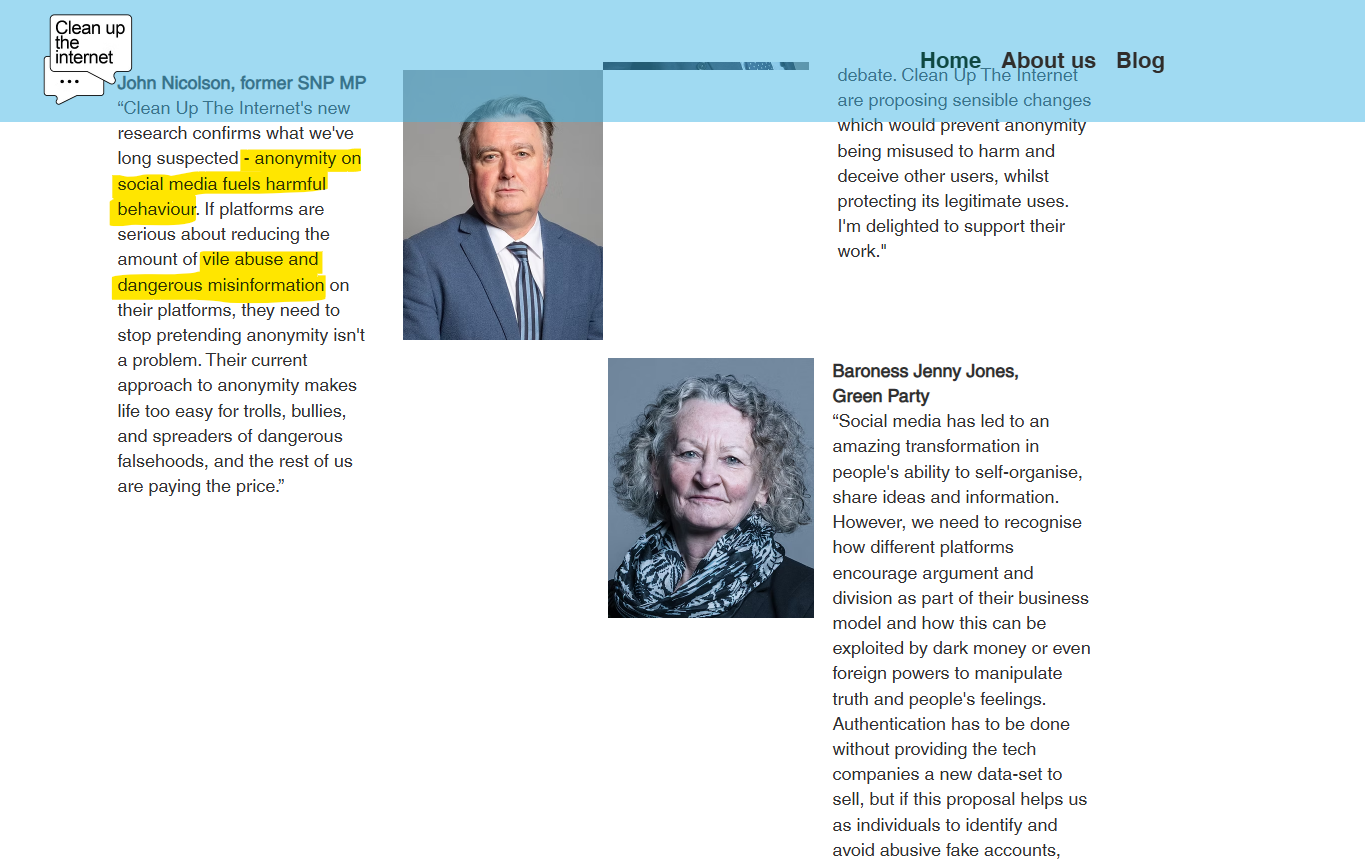
The proposed response was therefore not limited to identifying people suspected of committing an offence. It was to treat anonymity itself as the risk. For politicians tired of online criticism, the attraction was clear. Instead of answering, ignoring or individually blocking hostile users, they could filter out everyone unwilling to prove who they were.
What Clean Up the Internet wants
Clean Up the Internet’s proposal goes well beyond asking platforms to remove threats or prosecute fraud.
Its model rests on three measures:
- users should be offered identity verification;
- verification status should be visible;
- verified users should be able to filter out unverified accounts.
The group describes this as voluntary because nobody would be legally required to verify. But in evidence to Parliament, it said users who remained unverified could continue using social media only “albeit with certain limitations.”
Those limitations are the point.
Clean Up the Internet argued that visible verification would help users judge the “credibility and reliability” of an account’s content. It also wanted people to be able to block comments, messages and other interaction from every unverified account “as a category and pre-emptively.” An anonymous user would therefore not need to threaten, deceive or abuse anyone before being excluded. Refusing to submit to an approved identity check would be enough.
The group also contemplated verifying more than the existence of a real person behind an account. In a submission titled “Verification: What Works?”, it proposed checking a user’s true name and nationality or residency, and making those details visible. It also discussed verifying profile photographs and restricting the use of human images that had not been authenticated.
It later argued that platforms should accept credentials from approved third-party providers, allowing users to verify once and reuse that identity across multiple services.
The result would not necessarily be a classic real-name internet. Users might retain public pseudonyms, while platforms or approved providers knew who they were. But verification status could determine their credibility, visibility and access to platform features.
Nor does identity establish truthfulness. A verified politician or lobbyist can lie, while an anonymous whistleblower can be accurate. Yet Clean Up the Internet wants verification to function as a trust signal and non-verification as a warning.
The practical result would be a two-tier internet: the verified treated as more credible, while anonymous users become easier to filter and disadvantage.
How the proposal became law
Clean Up the Internet did not merely complain about anonymous users. It helped turn those complaints into legislation.
Its principal parliamentary ally, Siobhan Baillie, introduced the Social Media Platforms (Identity Verification) Bill in November 2021. The bill closely followed the group’s model by requiring major platforms to offer identity verification and allow users to limit interaction with accounts that remained unverified.
The government then inserted similar provisions into the Online Safety Bill.
During the Bill’s committee stage, Labour explicitly acknowledged the source of the policy.
Shadow minister Alex Davies-Jones said the revised Bill would give users “new options to verify their identity and filter out non-verified accounts,” adding: “This is in line with the approach recommended by Clean Up The Internet and also reflects the approach proposed in the Social Media Platforms (Identity Verification) Bill.”
Clean Up the Internet later said ministers had “adopted our proposal,” while Baillie claimed that the Bill contained verification measures “as a result of our work.”
The final Online Safety Act did not give the campaign everything it wanted. It did not require every user’s verification status to be displayed publicly, impose a universal real-name rule or define a single mandatory verification method.
The campaign’s influence is therefore unusually direct. A private advocacy group developed a response to anonymous “trolling,” recruited cross-party political supporters, and saw the central elements of its proposal written into British law.
Ofcom published draft guidance on the verification duty in July 2026. It has not proposed compulsory real names or mandatory verification for every adult. But Category 1 platforms will have to offer identity checks and allow users to filter content from non-verified accounts.
The draft also permits platforms to reward verified users, including through greater prominence in recommendation systems, while acknowledging that filtering may reduce the visibility of anonymous accounts. It says the unverified experience should not be “unduly degraded”—leaving room for some disadvantage.
Clean Up the Internet has criticized Ofcom for moving too slowly and failing to adopt stronger requirements. The group is now pressing Andy Burnham’s new government to intervene directly. In proposals it says were sent to the incoming Prime Minister’s team, Clean Up the Internet called for a more “muscular” approach from Ofcom, suggested replacing its leadership if necessary, and urged ministers to set a firm deadline for delivering user verification.
From “trolls” to digital ID
Clean Up the Internet now openly presents social-media verification as a route into Britain’s wider digital-identity system.
In 2024, the group said its proposals could “drive take-up of digital identity products” and “accelerate the development of a digital identity verification ecosystem in the UK.” It has also argued that platforms should accept credentials linked to BritCard, the GOV.UK Wallet and digital driving licences.
Its latest proposals are even more explicit. Clean Up the Internet has urged Burnham’s government to require platforms to accept credentials from certified digital-identity providers, including a free option based on the GOV.UK Wallet. It has also called for further legislation strengthening the Online Safety Act and an Elections Code of Practice covering disinformation, foreign interference and abuse.
That ambition sits within a much broader movement already documented by the Foundation for Freedom Online.
In Britain, the proposed under-16 social-media ban would require platforms to determine the ages of everyone seeking access. As FFO previously reported, enforcement could involve identity documents, banking information, biometric estimation or third-party digital-ID providers.
The push is also underway in the United States. Colorado lawmakers have proposed requiring operating systems to collect users’ dates of birth and send persistent age signals to apps and online services. California has pursued a similar device-level approach, while other states have imposed age checks directly on social-media platforms.
At the federal level, the Electronic Frontier Foundation has warned that the KIDS Act would pressure websites and applications to determine every user’s age, potentially through identity documents, facial scans or behavioural estimation systems. ([eff.org](https://www.eff.org/deeplinks/2026/06/kids-act-would-require-age-checks-get-online))
Foreign political leaders have been more candid about the implications for anonymity. German Chancellor Friedrich Merz has called for “real names on the internet,” insisting that people who criticise their country or society should do so under their identified names.
The security risks are equally clear. In March 2026, 405 cybersecurity and privacy experts from 30 countries warned that mandatory age-assurance systems could create infrastructure later used to deny access for reasons unrelated to safety. They also highlighted biometric collection, inaccurate age estimation, pressure against VPN use and breaches exposing government identity documents.
Clean Up the Internet therefore represents one strand of a wider project. Elsewhere, identity checks are justified through children and age restrictions. In this case, the original grievance was anonymous “trolling.” Both routes lead towards the same result: online participation increasingly conditioned on an approved digital identity.