Over the past year, curbing online free speech on American tech platforms has emerged as a major priority for governments around the world. The European Union (EU), the United Kingdom (UK), Brazil, Canada, Australia, Spain, Germany — all are simultaneously escalating pressure against American social media companies to censor speech and change their algorithms, in a seemingly coordinated effort to control online speech.
Spread across multiple countries, the emergent global censorship regime has the power to collectively fine social media platforms billions of dollars as percentages of their global revenue, cut off a platform’s business partners including advertisers and payment processors, ban access social media platforms across entire countries, and even jail American employees of tech companies that refuse to comply.
The global clampdown has seen massive fines levied against X, a threat to ban the platform across three countries, an actual ban of the platform in Brazil, the arrest of Telegram founder Pavel Durov in France, raids on the offices of social media companies, and, more recently, EU threats to fine TikTok if it does not remove “addictive” features.
Only the U.S. government has taken a stand against these censorship laws, and even that is tenuous: prior to the current administration, U.S. government agencies encouraged the spread of censorship laws around the world, using American taxpayer dollars to fuel the foreign censorship of Americans, including domestic political opponents like then-candidate Donald Trump.
While Trump’s new administration has taken a strong anti-censorship stance, deploying diplomatic pressure against foreign censorship via the Department of State, trade negotiators have so far failed to make the removal of foreign censorship laws a red line in their negotiations.
There are ways the U.S. could unilaterally blunt the force of foreign attacks on American speech. One method might be a tariff policy that imposes blanket tariffs on foreign countries in response to censorship fines, equal or greater to the amount of the fine, that would then be rebated to whichever American company is being targeted by foreign regulators. However, no efforts to establish such a policy are currently underway.
FFO Executive Director Mike Benz recently exposed the existential threat of the foreign censorship regime in a video. Benz argued that absent extraordinary U.S. pushback against foreign censorship, candidates in the 2028 Presidential election will be operating in an environment where their supporters’ ability to fight the election online is dictated by foreign governments.
A brief transcript:
“There will be 14 different discrete countries, as well as giant trade bodies like the EU that will pass coordinated, life-ending fines on social media companies if they carry any message that is a proxy for support for your candidacy.
By then, the social media companies will be under the gun. They don’t do it – they go bankrupt, unless you can stop them on their behalf. Or they can relent, and censor the speech, as a favor to the person who will certainly win the election if they go through with the censorship. They will look to you, and you will look helpless. And you will be helpless, because you will not have created the leverage to push back, or to push back in time for the election.
When they first issued that $140 million fine under the EU Digital Censorship Act, they were testing the waters to see if holy hell would be raised. If Trump might pull out of NATO for a month. If tariffs would spike to 300%. If French businessmen or German businessmen or EU businessmen in the United States were arrested, nothing. There was nothing. We might say it’s only $140. But what happens when it’s $140 billion instead of $140 million?
The platforms, no matter how much they like you, they’re not guaranteed that you’re going to win, if they hold off and accrue billions of dollars in fines hoping you win the election.
You are placing the platforms in an impossible position by not fighting for them now. You need a full-scale effort body-wide in the EU, both at the EU level and in each of the member states. There needs to be a progress bar, month over month, about what steps were taken within each member state country to convince them to pull out of the DSA, to convince the EU regulators that it will be far more costly for them to keep this regulation than it is to throw it away. And if you don’t do that, I am here from the future to tell you, you lost.”
The Global Censorship Regime
The following list shows how sprawling and dangerous the global censorship regime has become, in just a few short years.
Taken together, these laws represent a source of inexorable pressure on American tech platforms to censor not just foreign speech, but the speech of their own citizens, through global changes to content moderation departments and algorithms:
European Union: In December 2025, the European Commission fined X (formerly Twitter) €120 million (roughly $140 million in USD), for resisting content moderation demands under the Digital Services Act (DSA), including alleged failure to allow “disinformation researchers” to surveil the platform’s users at scale. A House Judiciary Committee report released in February 2026 revealed over 100 closed-door meetings since 2020 where EU officials pressured platforms like Meta, Google, and X to adopt stricter global rules, resulting in the censorship of lawful American content on political topics like COVID-19, migration, and debates on transgenderism. Most recently, the EU has demanded that TikTok, the American version of which is now fully US-operated, disable its “addictive” algorithm or face massive fines.
United Kingdom: Under the Online Safety Act, the UK established a tech enforcement regime similar to the EU’s, including fines of up to ten percent of a company’s global revenue for failing to comply with demands to censor disinformation or hate speech. The Act also allows UK authorities to bring criminal charges carrying jail time against platform employees, and force business partners like payment processors and advertisers to cut off a targeted platform. Since passing the OSA, the UK’s online regulator has repeatedly sought to pressure and fine American platforms, ranging from X to smaller sites like 4chan and KiwiFarms. More recently, UK Prime Minister Keir Starmer exploited a controversy over unsolicited bikini images on Grok to seek a joint UK-Canada-Australia ban on X.
Brazil: Supreme Federal Court Justice Alexandre de Moraes issued secret orders in 2025 demanding worldwide censorship of lawful speech, including content from US users, with no appeals process. Noncompliance resulted in nationwide bans on X and Rumble, frozen Starlink bank accounts, and a $2 million seizure from SpaceX.
Australia: In 2024, Australia’s eSafety commissioner threatened X with fines of A$785,000 a day (roughly $553,000 in USD) if it did not remove videos of a stabbing attack at a church in Sydney.
Canada: an Online Harms Act modeled on the UK’s Online Safety Act is currently making its way through the Canadian legislature. One of the proposed measures in the legislation is giving “human rights tribunals” the power to award compensation from tech companies to victims of “online hate speech.” Following the lead of the UK, Canada’s privacy commissioner also launched a probe into X over the Grok bikini pictures controversy.
Germany: In 2024-2025, German authorities ruled that certain tweets, including one calling for deportation of a Syrian family, constituted incitement to hatred, pressuring platforms like X to remove them globally under threat of fines. This aligns with broader EU DSA enforcement, where Germany flagged content for removal that challenged government agendas.
France: In early 2026, French authorities raided X’s Paris office over allegations of antisemitism, part of ongoing probes tied to EU-wide content rules. Earlier, in 2024, French police requested X remove a US-based post blaming immigration policies for a terrorist attack, extending censorship demands extraterritorially. France also arrested and charged Telegram founder and CEO Pavel Durov, allegedly over criminal activity on the app — but Durov later claimed he was being pressured by French authorities to censor elections in Romania.
Spain: the left-wing government in Spain recently announced a package of measures aimed at regulating social media companies, including a total ban on social media use for under-16s, criminalizing the algorithmic amplification of “harmful” content, and mandatory requirements for tech companies to track “hate and polarization” on their platforms. Like the new censorship regimes in the UK and Brazil, Spain’s penalties include potential criminal charges and jail time for platform executives who fail to comply.
How the U.S. Permanent Bureaucracy Enabled It
Although the current U.S. administration is vocally opposed to the escalating foreign attacks against Americans’ free speech infrastructure, and has largely cut any government programs that supported it, this represents a major break from the past. Prior to this administration, the same global censorship regime that now threatens Americans’ right to speak online was being actively supported, funded, and encouraged by U.S. government agencies.
It began shortly after President Trump’s first election victory in 2016, when large sections of the U.S. civil service resolved to combat and undermine his agenda. Many of the government agencies that silently worked against the elected President in those days determined that online free speech was responsible both for Trump’s success in the U.S., and the rise of populist parties around the world — a trend that they believed threatened their global grip on power.
The centrality of combating Trump can be seen in both domestic efforts, like DHS’s Election Integrity Partnership, which facilitated the censorship of the President’s supporters on social media, and foreign ones.
The U.K.
For example, the Congressionally funded National Endowment for Democracy (the $300m annual budget of which was recently re-approved with Republican votes), directly funded the British Global Disinformation Index (GDI). The GDI would later brag to its funders at NED that it had successfully reduced Trump’s reach on social media.

These foreign efforts included direct support for the establishment of the same foreign censorship laws that now target U.S. companies.
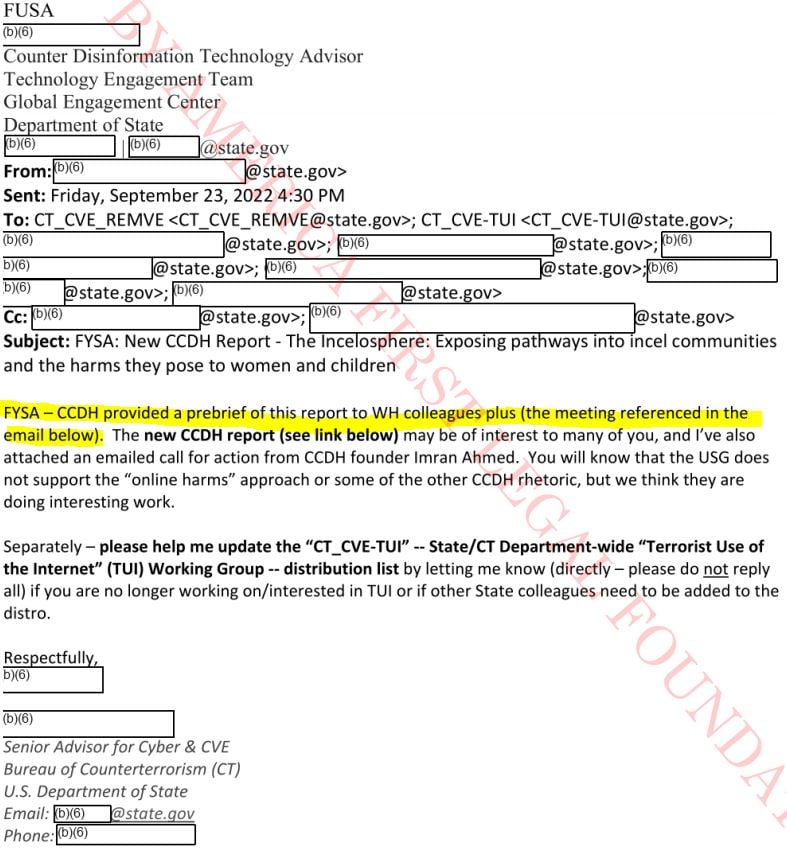
Collaboration with the British went beyond the GDI. The Center for Countering Digital Hate (CCDH), which directly shaped and supported the UK’s Online Safety Act, was closely tied to the previous administration. CCDH has become an infamous name in the censorship industry, after leaked internal emails showed one of its top goals is to “kill Musk’s Twitter.”
As well as President Biden’s direct support for the censoring of individuals on CCDH’s COVID-19 “Disinformation Dozen” in 2021, CCDH also gained direct access to the State Department, with officials recommending its work to staffers.
CCDH, which was founded by UK Prime Minister Keir Starmer’s former top aide, Morgan McSweeney, would go on to be a key consulting partner for the UK government’s Online Safety Act, which is now used to target X and other American tech companies.
The European Union
During the previous administration, the U.S. International Trade Administration established a series of working groups with EU regulators, including a working group on addressing “harmful content and their algorithmic amplification.”
The result of these working groups was the U.S. and the EU expressing a “shared view” on tech platforms’ impact on “information integrity and public discourse,” as well as “disproportionate impacts on vulnerable, marginalized, or underrepresented communities.”
Critically, the U.S. – EU statement said that “voluntary initiatives,” like the EU’s voluntary code of practice on disinformation, were not sufficient to constrain the tech platforms. This was a direct expression of U.S. support for what became the world’s most powerful censorship regime: the Digital Services Act.

The direct censorship collaboration between the US and EU via the previous administration’s Trade and Technology Council exposes a deep level of transatlantic coordination in the establishment of the DSA.
But there are also a great deal of indirect links. As FFO previously revealed, 23 US-funded organizations – a mixture of NGOs, university research departments, and private companies – are involved in the EU’s censorship regime.
Some were signatories to the EU’s code of practice on disinformation, while others are directly enforcing the DSA through participation in the EU’s network of “digital observatories,” which monitor online speech at scale. These are the same digital observatories that the EU hopes, through its $140 million fine, to force X to open up its platform to.
Even in exile, the previous administration continues to encourage foreign attacks on American tech companies. Nina Jankowicz, formerly head of the Biden Administration’s short-lived DHS Disinformation Governance Board has been on a worldwide tour over the past few years, appearing before the EU, UK, and Canadian parliaments, where she urged foreign regulators to “resist” the current administration and establish more speech controls on American companies.
Brazil
U.S. tax dollars also funded the growth of the censorship regime in Brazil, which was later turned on Elon Musk’s companies. In 2021, the U.S. funded Brazilian researcher Marco Ruediger gave a presentation calling for a ban on the “international movement to exchange ideas” between pro-Bolsonaro groups in Brazil and pro-Trump groups in the US:
The host of the event was the International Institute for Democracy and Electoral Assistance (“International IDEA”), which is funded by USAID and the National Democratic Institute (“NDI”), both of which derive their funding from annual government allocations made by the US Congress:
The featured speaker in the video above, Prof. Ruediger, is a founding advisory board member of the Design 4 Democracy Coalition (“D4D”), which is also taxpayer-funded by the NDI and its sister group, the International Republican Institute (“IRI”). The NDI and IRI form the two explicitly partisan branches — representing the Democrat and Republican parties respectively — of the National Endowment for Democracy.
In a special edition of its newsletter dated November 18, 2022, D4D stated that Musk’s takeover “harms the future of Twitter,” and – just days into the platform’s new ownership – speculated about potential billion-dollar FTC fines against the company.

In one media appearance, Ruediger called for a new constitution to contain the “evil” of disinformation. While his advice to Brazil’s TSE is less public, it can be assumed that his recommendations for the country’s censorship court are along similar lines.
To accomplish this in Brazil, Ruediger has told Brazilian lawmakers and future prosecutors that the country needs to activate every “institutional, state and civic apparatus,” and “institutional improvements in the structure of the Brazilian State, of Brazilian institutions” to combat disinformation.
Foreign Controlled Speech Infrastructure
Social media no longer plays second fiddle to the legacy press. It is now the foremost conduit for spreading news and opinion, and contesting narratives in an election. If foreign governments are allowed to seize control of the content moderation policies of American platforms through fines, criminal penalties, and other regulation, this will effectively give them control over the course of elections in the U.S.
The international approach taken by the censorship industry is one that bypasses the First Amendment not by challenging it directly, but by outsourcing censorship to foreign states—an end-run around constitutional limits, carried out in the name of “information integrity,” and coordinated across borders. If it is not defeated, it is not just online content but American democracy itself that will effectively be regulated by foreign regimes.