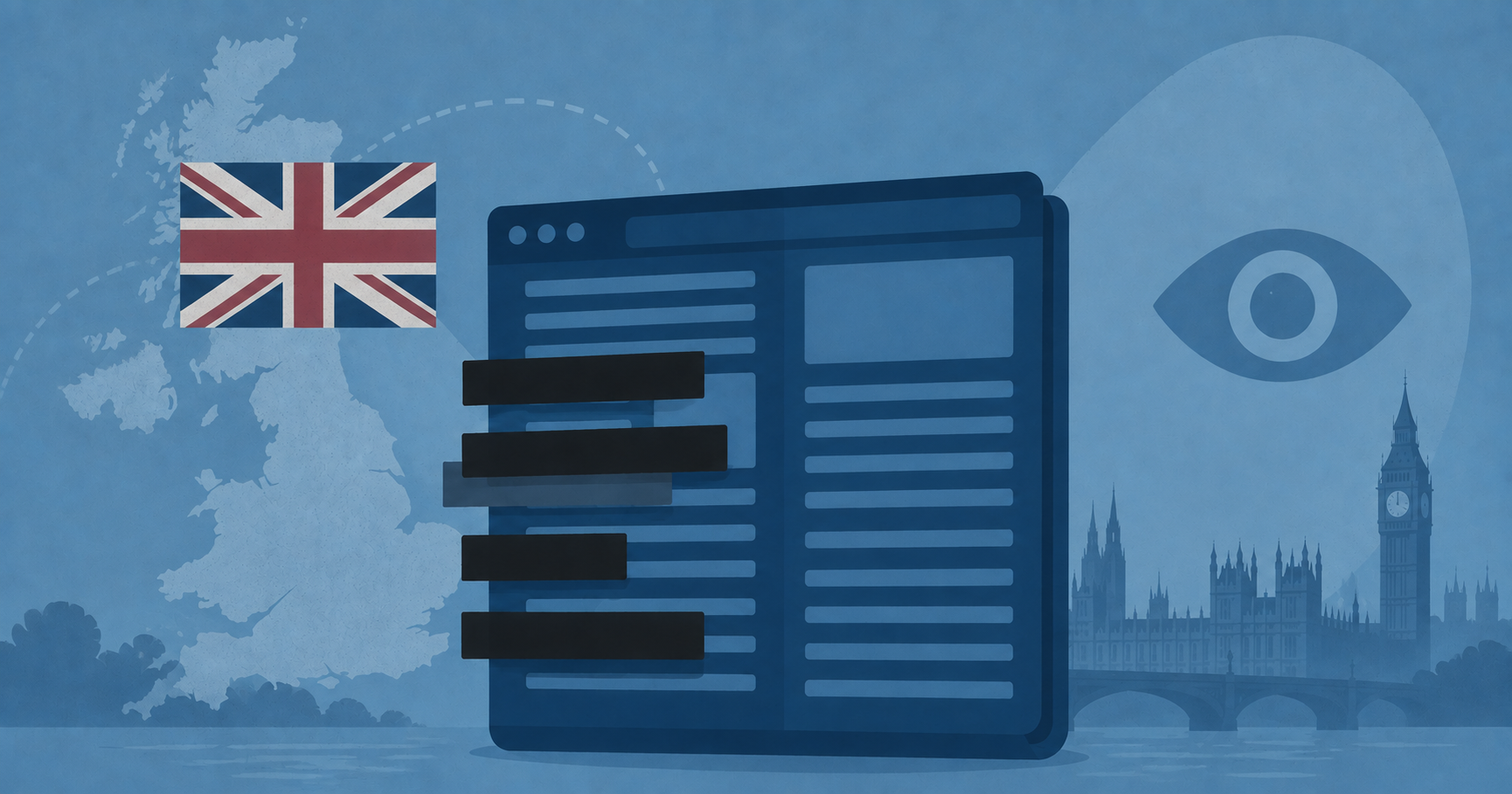
The United Kingdom’s expanding online censorship regime may soon take aim at one of the internet’s most widely used privacy tools.
In a new policy statement framed around “giving children the space to grow,” Prime Minister Keir Starmer – currently embroiled in scandal over his former U.S. ambassador’s links to Jeffrey Epstein – signaled that his government is prepared to clamp down on Virtual Private Networks (VPNs) and other tools that allow users to bypass age-verification systems established under the Online Safety Act.
While presented as a child-safety initiative, the announcement builds on escalating enforcement powers embedded in the Online Safety Act, one of the most sweeping censorship frameworks in the democratic world. As FFO has previously documented, the Online Safety Act enables the following:
- Fines of £18 million or 10 percent of worldwide revenue against companies that fail to take down “disinformation” or “hate speech.”
- The power to compel a online company’s advertisers and payment providers to cut off a non-compliant company.
- The power to compel UK internet service providers to block access to a site entirely
Starmer’s government, as well as the UK’s internet regulator Ofcom, have aggressively deployed their new powers to target Elon Musk’s X, as well as smaller sites like 4chan and KiwiFarms, part of a wider global regulatory assault on American online speech.
Now, VPNs are being cast as an obstacle to enforcement.
Government officials have previously declined to rule out restricting VPN services if they are used to evade content controls. Digital Minister Michelle Donelan acknowledged last year that the government was examining ways to address what it views as “workarounds” to the law’s requirements. Lawmakers have similarly suggested that banning or limiting VPN access could be considered if companies fail to prevent circumvention.
Nevertheless, the decision by the embattled Prime Minister to take the plunge on VPN restrictions marks a significant escalation of the country’s already-draconian censorship regime.
VPNs are widely used by businesses securing remote workforces, journalists protecting confidential sources, dissidents evading surveillance, and ordinary citizens safeguarding personal data on public Wi-Fi.

If Starmer is successful, the UK would join a small club of countries that enforce restrictions on VPNs – a list that includes China, Russia, Belarus, North Korea, Turkey, Egypt, Iraq, and Iran.